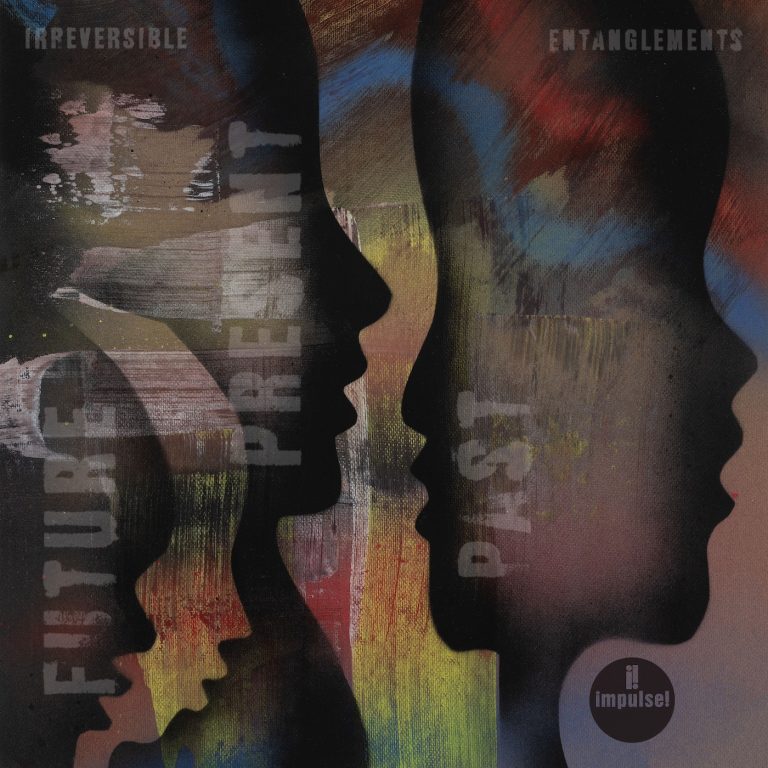
Irreversible Entanglement’s Future Present Past arrives like something already in motion—less a new statement than a continuation of an ongoing transmission.
Recorded in part at Van Gelder Studio and released through Impulse!, the album situates itself inside a lineage that it doesn’t just reference, but actively disrupts. This is a record concerned with time, but not in any linear or sentimental sense. The title gestures toward sequence, but the music refuses it. Past, present, and future collapse into a single field of pressure—one shaped by memory, resistance, and the unfinished work of survival. The band has always worked in this space, but here, that temporal density feels heightened, more deliberate.
Moor Mother’s voice remains the axis. She doesn’t guide the listener so much as reposition them. Her delivery—part invocation, part document—moves through fragments that feel pulled from a living archive. On tracks like “Don’t Lose Your Head” and “Vibrate Higher,” her phrasing cuts sharply against the ensemble, refusing resolution while insisting on clarity. These are not poems meant to be absorbed; they are conditions to be confronted.
Around her, the ensemble expands its language without smoothing its edges. The addition of collaborators like MOTHERBOARD and Helado Negro introduces new textures—layered vocals, moments of density that border on the choral—but the music never settles into cohesion for its own sake. Keir Neuringer’s saxophone still operates as a kind of searching force, lines stretching and splintering rather than resolving. Luke Stewart’s bass resists the idea of foundation as stability—it grounds, but it also unsettles. Tcheser Holmes approaches rhythm as something to be interrogated rather than maintained, while Aquiles Navarro’s trumpet punctuates the music with bursts that feel both ceremonial and disruptive.
What emerges across the album’s ten tracks—titles like “Juntos Vencemos,” “Panamanian Fight Song,” and “We Overcome”—is a collective practice that treats improvisation not as exploration, but as necessity. The music draws from free jazz, global traditions, and spoken word, but it refuses to be contained by genre. Instead, it situates itself within a continuum of Black experimental music that understands sound as both expression and method of resistance. There is a sense, throughout, of standing “on the shoulders of legions”—a phrase the band uses to describe the project, invoking ancestors, rebels, and builders of alternate futures. And you can hear that weight.
What Future Present Past ultimately resists is distance. It doesn’t aestheticize urgency or translate it into something more palatable. It stays with the tension. It asks the listener to do the same.
Nothing resolves here. Nothing is meant to.
 Publik / Private