October 29: When Scorpio Creates a President


The Shared Birthdate of Ellen Johnson Sirleaf and Netumbo Nandi-Ndaitwah

History loves a coincidence, but sometimes a coincidence feels more like a pattern hiding in plain sight. Two African presidents—born decades apart, raised in different political realities, shaped by different revolutions—share the exact same birthday: October 29. Ellen Johnson Sirleaf arrived first, in 1938, in Monrovia, Liberia. Years later, in 1952, Netumbo Nandi-Ndaitwah was born in northern Namibia, then a territory under South African rule. One would become the first democratically elected female head of state in Africa. The other would become the first woman to lead Namibia.

Same date. Same astrological season. Two political lives defined by endurance.

Astrology is often dismissed as mysticism, but it can also function as narrative language—a symbolic system for understanding temperament, timing, and the strange rhythms that seem to echo through history. October 29 falls deep inside Scorpio territory, a sign traditionally associated with transformation, survival, and psychological acuity. Scorpio is ruled by Pluto, the planet of rebirth, and historically linked with Mars, the force of confrontation and courage.

In less cosmic terms, Scorpio energy is about resilience. It belongs to people who do not panic when systems collapse. It belongs to people who can sit inside chaos long enough to rebuild something from it.

Look closely at the political biographies of Sirleaf and Nandi-Ndaitwah and the symbolism begins to feel less abstract:

Sirleaf’s story is inseparable from Liberia’s own turbulence. Long before she reached the presidency, she had already lived through the pressures that often fracture political careers: clashes with authoritarian rule, imprisonment, years spent in exile. She moved between international financial institutions and the shifting terrain of Liberian politics while her country cycled through instability and civil war. By the time she won the presidency in 2005, Liberia was emerging from years of violence and institutional collapse. The work ahead of her was not glamorous. Rebuilding a nation rarely is. It meant restoring international confidence, repairing public institutions, and slowly guiding a traumatized country back toward political stability. Over time, Liberia reestablished relationships with global partners, restructured portions of its economy, and strengthened democratic processes under her administration.

If Scorpio has a governing myth, it is the phoenix—the creature that passes through fire before it rises again. Sirleaf’s presidency feels almost mythologically aligned with that story: a leader shaped by political hardship who ultimately presided over a period of national renewal.

Nandi-Ndaitwah’s political life carries a different chapter of the same archetype. She grew up in a Namibia that had not yet achieved independence. As a teenager she joined the liberation struggle through the South West Africa People’s Organization, the movement that fought for Namibia’s freedom from South African rule. Political activism brought detention and eventually exile, where she continued organizing internationally while studying abroad.

For many people, exile deeply interrupts life. For women like this,  it defines it.

When Namibia gained independence in 1990, Nandi-Ndaitwah returned to help build the government of a brand-new country. Over the decades that followed she became one of the most experienced figures in Namibian politics, holding key positions in diplomacy and national leadership before ultimately winning the presidency in 2024. Sirleaf’s leadership reflects Scorpio’s power to rebuild after destruction, Nandi-Ndaitwah’s career illustrates another trait astrologers often attribute to those born on October 29: patience. Not the passive kind, but the strategic variety—the ability to commit to a political project for decades without losing clarity or momentum. Astrologers sometimes describe October 29 individuals as possessing a heightened sense of perception. Scorpio is often characterized as the sign that notices what others overlook. It is deeply observant, instinctively aware of the unspoken dynamics operating beneath institutions and personalities. In politics, that translates into a rare kind of intelligence: understanding power not as spectacle, but as structure.

For women navigating political systems historically dominated by men, that form of awareness becomes particularly valuable. Both Sirleaf and Nandi-Ndaitwah rose through environments that did not necessarily anticipate female leadership. Neither arrived in power through sudden celebrity or charismatic populism. Their authority developed gradually, built through years of negotiation, strategy, and institutional knowledge. In other words, their leadership looks exactly like what Scorpio energy is supposed to produce: long arcs rather than quick victories. There is also a quiet symbolism in the fact that both women eventually became national firsts. Sirleaf’s election in Liberia signaled a historic shift not only for the country but for the continent, proving that a woman could lead a modern African democracy through the ballot box. Years later, Nandi-Ndaitwah’s presidency in Namibia reinforced that trajectory, extending the lineage of women shaping the political future of the continent.

Two nations with different histories arrived at similar milestones through leaders born on the same day. Astrology describes Scorpio as the sign of thresholds—the moment when one reality dissolves and another begins to form. It governs transformation, the uncomfortable but necessary process of moving from one political or emotional state into another. Seen through that lens, the shared birthday of Sirleaf and Nandi-Ndaitwah begins to feel less like trivia and more like symbolism embedded in history. Both women stepped into leadership during periods when their countries were negotiating identity, stability, and the meaning of sovereignty in a changing world. Symbols matter, especially when they reveal something about character. And if October 29 carries a particular cosmic script, it seems to favor leaders who understand power as something forged through experience rather than inherited through privilege.

Two women born under the same Scorpio sky spent their lives navigating revolution, exile, diplomacy, and the slow mechanics of national transformation. Eventually, both stepped into the highest office in their countries—not as anomalies, but as the culmination of decades of work.

Perhaps the stars do not write history.

But sometimes they sketch an outline.
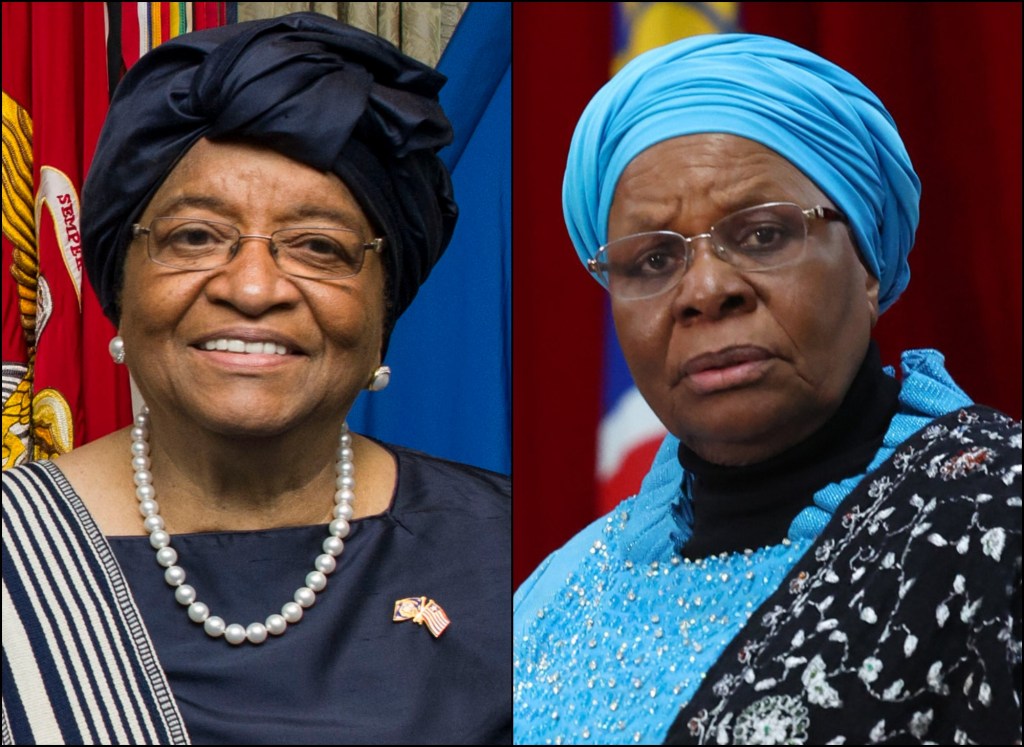
P / P Essay: Ellen Johnson Sirleaf & Netumbo Nandi-Ndaitwah: Presence and Pragmatism

Ellen Johnson Sirleaf and Netumbo Nandi-Ndaitwah offer a stark reminder of the vital role women play in shaping the continent’s future. Both of these leaders—one from Liberia, the other from Namibia—have not only defined their nations’ political histories but have also become symbols of strength, resilience, and the importance of female leadership in the broader African context. Their careers, while shaped by different historical and cultural forces, speak to the transformative power of leadership that transcends gender.

Photos available via Creative Commons

Ellen Johnson Sirleaf’s place in history is firmly anchored in her role as Liberia’s first female president, a position she held from 2006 to 2018. Her rise to power came after years of struggle—political exile, imprisonment, and the devastating aftermath of Liberia’s civil war. Sirleaf’s journey to the presidency was a testament to her unwavering commitment to national recovery, resilience, and reform. Her leadership during Liberia’s post-conflict era was instrumental in stabilizing a nation that had been torn apart by violence and rebuilding its institutions from the ground up.

Sirleaf’s tenure was defined by a pragmatic approach to governance. She focused on restoring international relations, securing debt relief for Liberia, and laying the groundwork for economic recovery. Under her leadership, Liberia’s economy began to stabilize, foreign investments flowed in, and peace began to take hold. Her achievements were not without challenges, but Sirleaf’s diplomacy and economic strategies helped Liberia secure its place on the world stage. Perhaps her most lasting legacy is her advocacy for women’s rights. Sirleaf’s presidency marked a turning point for women’s political participation in Liberia. She implemented policies aimed at addressing gender-based violence, expanded educational opportunities for girls, and created pathways for women to take active roles in the workforce. Her leadership demonstrated the tangible difference a woman in power could make—not just in terms of policy, but in shaping societal attitudes about the capabilities of women to lead.

While Sirleaf’s leadership was focused on rebuilding a post-war Liberia, Netumbo Nandi-Ndaitwah’s influence has been felt on the diplomatic stage of Southern Africa and beyond. As Namibia’s Deputy Prime Minister and Minister of International Relations and Cooperation, Nandi-Ndaitwah has been a prominent advocate for regional unity and African solidarity. Her career is deeply intertwined with Namibia’s liberation struggle, where she fought against apartheid and colonial oppression. This experience laid the foundation for her role as a political figure who is committed to both domestic growth and regional collaboration.

Nandi-Ndaitwah’s work in diplomacy has placed Namibia at the center of conversations about Africa’s future. She has worked to strengthen Namibia’s relationships with its neighbors, while also representing the nation on the global stage. As a respected voice in the African Union (AU), she has championed the idea of a united Africa, working tirelessly to foster Pan-African cooperation. Nandi-Ndaitwah’s leadership is characterized by her ability to balance national interests with the broader goals of continental unity. At the heart of Nandi-Ndaitwah’s leadership is a commitment to gender equality. Throughout her political career, she has advocated for policies that promote the economic and political empowerment of women, ensuring that women are not only beneficiaries of national development but also active participants in shaping that development. Her contributions to advancing gender parity are a testament to her belief that women must be present at every level of decision-making, both in Namibia and throughout Africa.

Despite the differences in their political contexts, Ellen Johnson Sirleaf and Netumbo Nandi-Ndaitwah share a number of defining qualities that have shaped their leadership. Both women’s careers reflect a commitment to women’s rights and the importance of female representation in governance. They have each shown that women, even in the most challenging political environments, can lead with vision and integrity.

Both Sirleaf and Nandi-Ndaitwah understand that leadership is not simply about holding power—it is about using that power to effect real change for people. Sirleaf’s efforts to rebuild Liberia were focused on stabilizing a nation fractured by war, while Nandi-Ndaitwah’s work has been dedicated to strengthening Namibia’s place in a broader African context. Each has focused on ensuring that women are not just beneficiaries of the systems they create but that they are key architects of those systems. Their leadership has also been marked by resilience in the face of adversity. Sirleaf, who faced exile and imprisonment for her opposition to Liberia’s previous military regimes, returned to her home country to lead it through one of its most challenging periods in history. Similarly, Nandi-Ndaitwah’s involvement in Namibia’s independence struggle gave her the foundation to serve as a diplomatic force in the post-independence government. Their paths have been shaped by trials and setbacks, yet both women have emerged as exemplars of what it means to overcome obstacles in pursuit of justice and equity.

While Sirleaf and Nandi-Ndaitwah share common values and goals, their leadership styles and areas of influence differ, reflecting the unique political environments in which they have worked. Ellen Johnson Sirleaf’s leadership was largely focused on Liberia’s recovery in the aftermath of civil war. Her presidency required practical, hands-on approaches to nation-building, focusing on economic reform, infrastructure, and establishing a secure environment for growth. Sirleaf’s legacy in Liberia is one of stabilization and recovery—a model for how nations can rebuild after conflict through diplomacy, international cooperation, and a focused commitment to peace.

Netumbo Nandi-Ndaitwah’s work has been more outward-facing, focused on regional and continental diplomacy. Her role in Namibia’s government has extended beyond the borders of her own country to the broader African continent. As Deputy Prime Minister, Nandi-Ndaitwah’s work on behalf of African unity and development has made her a respected figure in the African Union. She has advocated for a stronger, more integrated Africa, where countries collaborate to address shared challenges and ensure the continent’s global competitiveness. While Sirleaf’s work was centered on national reconstruction, Nandi-Ndaitwah’s focus has been on positioning Namibia—and Africa as a whole—as influential players in the global arena.

Ellen Johnson Sirleaf and Netumbo Nandi-Ndaitwah are two of Africa’s most prominent women leaders, and their legacies underscore the importance of female representation in governance. Their careers have shown that women can lead not only in times of crisis but also in times of stability, shaping the future of their nations and the continent at large. Their leadership reminds us that true progress cannot be achieved without inclusive representation and that the power of women’s voices in politics is indispensable.

Both women have paved the way for future generations of African women to engage in political life, not as exceptions but as integral figures. Their stories demonstrate the profound impact of women in leadership roles, offering models of governance that center on integrity, resilience, and empowerment. Sirleaf and Nandi-Ndaitwah have demonstrated, through their respective leadership journeys, that when women lead, the entire nation benefits, and the continent moves closer to the ideals of justice, equality, and sustainable development. In looking to the future, it is clear that the work of Ellen Johnson Sirleaf and Netumbo Nandi-Ndaitwah is far from over. Their leadership has laid a foundation for African women to continue breaking barriers, advocating for justice, and building the world they wish to see. As we reflect on their legacies, we are reminded that leadership—true leadership—is about vision, resilience, and the unwavering belief in the potential of people, particularly those who have historically been excluded.

Their stories serve as both inspiration and challenge: to women everywhere, and especially to African women, to step into their power and continue the work of building a more inclusive, equitable future.

Publik / Private Essay: on Gisèle Pelicot’s call to survivors

Gisèle Pelicot in 2024 – Publik / Private does not own this photo.

There are moments in public life that do more than interrupt the news cycle; they rupture the very architecture of shame itself. Gisèle Pelicot’s emergence into collective consciousness is one such rupture. What she has invited the world to witness, to feel, and to reconsider is not simply her own story—harrowing as it is—but the deeper social lie that murder, theft, and assault leave stains on the victim’s soul, and that humiliation is a cost to be absorbed quietly, in private.

This lie is ancient, pernicious, and coded deeply into the way society talks about sexual violence. It insists that the violated should cover their wounds, carry their pain behind closed doors, and perform discreet silence as if harm is a private blemish. Gisèle Pelicot refused this inheritance. In the mass rape trial that unfolded in Avignon, she did something extraordinary: she waived her right to anonymity and demanded the trial be public. She said she wanted “all women victims of rape … to say: Madame Pelicot did it, we can do it too.” And she declared with quiet gravity that “when you’re raped there is shame, and it’s not for us to have shame – it’s for them.”

To say “never have shame” in a world that reflexively trains victims to internalize blame is to challenge the very grammar of violence. Shame doesn’t spring from the wound itself; it is a social product, a mechanism that protects power by making the vulnerable feel small, isolated, and unworthy of witness. Pelicot stood against that mechanism, insisting that the weight of disgrace belongs not with the one attacked, but with those who inflicted the harm. 

This shift—simple in phrase but seismic in effect—is a reallocation of moral responsibility. Pelicot’s experience was nearly unimaginable in its scope: over many years, while drugged unconscious by her husband, she was raped repeatedly by dozens of men he invited into their home. The revelations emerged only after police investigating unrelated voyeurism found disturbing footage on her husband’s computer, revealing the systematic nature of the abuse. 

The instinct of the criminal justice system in many societies is to protect the privacy of victims, to sequester their experiences in sealed rooms and sealed pages. But Pelicot refused this protection precisely because that privacy historically serves perpetrators far more than survivors. By opening the courtroom to the public gaze, she made the crime visible on her terms. She turned the spotlight from hidden shame to exposed accountability. The shame was no longer something lodged in her voice or bowed shoulders; it was something placed squarely on the acts of her husband and the men who participated with him. 

Her words—it’s not for us to have shame, it’s for them—are not a palliative or a slogan. They are a methodological shift in how we think about collective responsibility. When Pelicot articulated this during her testimony, she was not issuing a comforting platitude; she was proposing a restructuring of who bears the emotional and moral cost of violence. Victims are too often taught to apologize for surviving. Her stance interrupts that conditioning. 

And yet, there is humility in her refusal of the language of heroism. When observers called her brave, she deflected—not because she was unheroic, but because courage abstracted from consequence is a story we tell to feel comfortable again. Pelicot described her persistence as “will and determination to change society,” not simply personal endurance. Courage for her was not a static trait but a sustained commitment to truth-telling in the face of denial, minimization, and cultural avoidance.

In insisting that victims should “never have shame,” Pelicot forces us to examine the structures that scaffold shame in the first place. What does it mean that we accept a culture where consent is poorly understood, where “I didn’t think it was rape” is offered as a defense? What does it mean that survivors must navigate not only the trauma of assault but the expectation of self-silencing? These questions are not rhetorical. They point toward the very conditions that allow violence to become normative rather than aberrant. 

There is no quick fix here, no singular legislative moment that will instantly dissolve centuries of conditioning. But there is a shift that begins in language and extends into empathy. When we stop locating shame in the body of the victim and start locating it in the conduct of the perpetrator, we begin the work of dismantling stigmas that function as social glue, holding in place systems that protect the powerful and isolate the vulnerable.

Pelicot’s call is, at once, an invitation and a demand. She invites survivors to reject the internalization of shame. She demands that society change the terms of its moral imagination. To reject shame is to reclaim narrative authority over one’s own life. It is to declare that harm is not a mark of dishonor but a testament to an injustice that must be addressed, not hidden.

In a cultural moment saturated with testimonies—some celebratory, others mournful—Pelicot’s voice resonates because it refuses to locate dignity in silence. Her message matters because it disassembles a foundational assumption: that victims should be quiet. Instead, she insists that silence belongs to the perpetrators who hide their acts behind euphemism and denial.

This is not merely about visibility. It’s about truth. To say “never have shame” is to assert that survivors deserve a world where their stories are not obstacles to justice but bridges to change.

And if we are listening—truly listening—we might begin to understand that the redistribution of shame is not an act of forgiveness, but an act of radical accountability.