On Linda Goodman, Liz Greene, and the quiet seduction of making sense of love
The Aesthetics of Compatibility: Celestial Narratives of the Heart
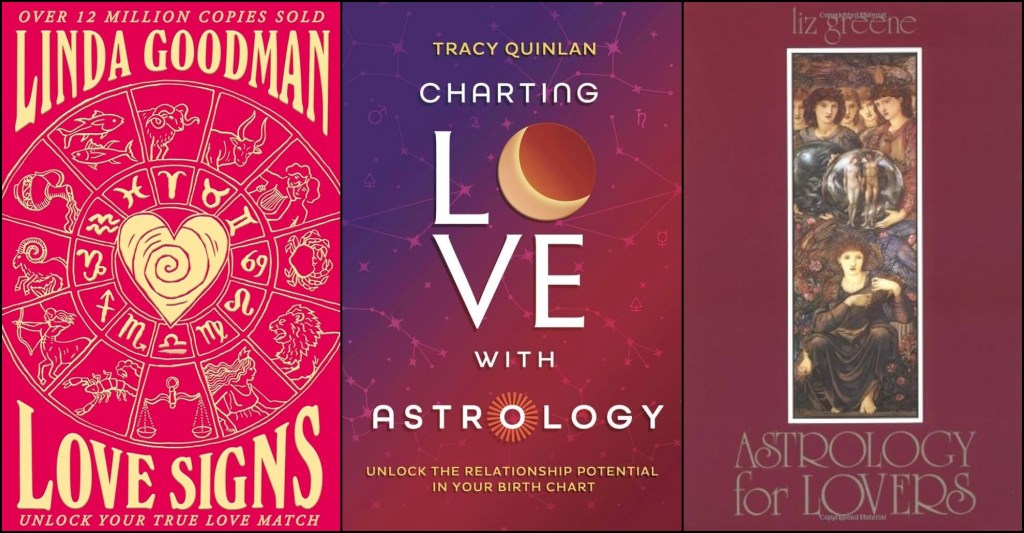
There is something faintly illicit—almost decadent—about reading astrology as literature rather than an instruction manual: The trio of Love Signs, Astrology for Lovers, and Charting Love with Astrology sit at that threshold: between guidance and gossip, between myth and mirror. They are not just books about love; they are artifacts of how we have wanted love to make sense.
To read Love Signs is to enter a maximalist cosmos where romance is both destiny and drama. Linda Goodman writes like an aunt who has seen too much and refuses to be boring about it. The book’s structure—every sign paired with every other—feels almost compulsive, as if love could be solved through sheer thoroughness. And yet, what lingers is not the taxonomy but the tone: lush, excessive, occasionally unhinged. Goodman doesn’t simply describe compatibility; she narrates it, layering emotional prediction with moral suggestion, as if each relationship were already a story waiting to be confirmed. The appeal lies in its intimacy. It promises that your private chaos has already been written somewhere, that even your worst patterns have a celestial precedent. As one overview notes, the book explores “each possible combination of signs…in detail,” offering insight into everything from conflict to desire.
Liz Greene’s Astrology for Lovers reads like a corrective—cooler, more psychological, quietly skeptical of astrology’s own clichés. Greene is interested not in who you should date, but in why you want what you want. Her approach reframes astrology as a language of inner life rather than external fate. Each sign becomes less a personality type than a pattern of longing, complete with contradictions and shadow selves. She draws on myth and psychology, mapping desire as something shaped by unconscious drives as much as planetary alignments.
Reading Greene after Goodman feels like stepping out of a velvet-draped parlor into a therapist’s office. The drama is still there, but it has been internalized. Love is no longer something that happens to you; it is something you participate in, often against your own better judgment. Greene’s lovers are not star-crossed—they are self-sabotaging, self-seeking, self-aware. And somehow, that makes the stakes feel higher.
Then there is Charting Love with Astrology, a more contemporary entry that synthesizes both impulses: the narrative pleasure of Goodman and the analytical rigor of Greene. It leans into the language of charts—synastry, aspects, houses—treating love as a system to be mapped rather than a mystery to be endured. Where Goodman offers archetypes and Greene offers psychology, this book offers structure. It assumes that love is legible, if only you learn how to read it properly.
And yet, even here, the promise is not certainty but clarity. Astrology becomes a tool for decoding relational dynamics: why attraction sparks, why conflict repeats, why certain people feel inevitable. It suggests that compatibility is not a yes-or-no question but a set of tensions to be negotiated. In this sense, it reflects a broader cultural shift—from fate to framework, from destiny to design.
What connects all three books is not their accuracy (a question that feels beside the point) but their insistence that love is meaningful. Not random, not purely biochemical, not entirely within our control. They offer different fantasies of coherence. Goodman gives us the fantasy of narrative—that everything, even heartbreak, fits into a story. Greene gives us the fantasy of understanding—that if we look closely enough, we can know ourselves. And Charting Love gives us the fantasy of mastery—that with the right tools, we can navigate intimacy more skillfully.
To read them now, in an era of dating apps and algorithmic compatibility, is to encounter a different kind of algorithm—one that is slower, stranger, and far more poetic. These books do not optimize love; they complicate it. They ask you to linger in ambiguity, to consider that your desires might be patterned but not predictable.
And perhaps that is the enduring appeal of astrology, especially in matters of the heart. It does not solve love. It aestheticizes it. It turns confusion into symbolism, longing into language. It allows us to believe, if only for a moment, that the chaos of intimacy might be written in the stars—not to limit us, but to make the experience feel larger than ourselves.
In the end, these texts are less about who we should love than about how we narrate love to ourselves. Whether through Goodman’s cosmic melodrama, Greene’s psychological depth, or the chart-driven logic of contemporary astrology, they remind us that love has always been, at its core, an interpretive act.

