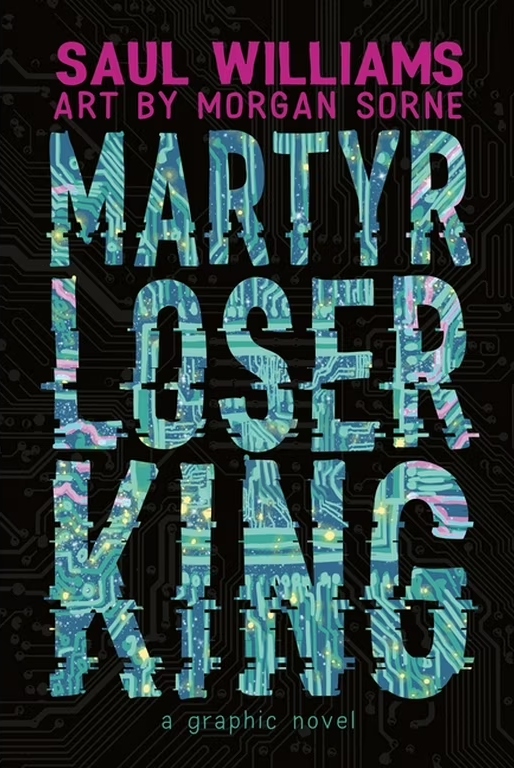
Some writers describe the future as if it is waiting patiently for us somewhere down the road. Saul Williams has always understood the future differently — as something already leaking through the walls of the present. In his work, prophecy does not arrive polished or distant; it arrives overheated, grief-stricken, ecstatic, carrying the language of revolution in one hand and spiritual hunger in the other. For more than two decades, Williams has occupied a singular space in American art: part poet, part theorist, part musician, part witness to empire’s psychological collapse. His work does not simply critique the world we live in. It interrogates what surviving that world does to the spirit.
With Martyr Loser King, his graphic novel created alongside multidisciplinary artist Morgan Sorne, Williams expands a universe he has been building for years across music, film, poetry, and performance into something tactile, feverish, and deeply immersive. The story shares connective tissue with his 2016 album of the same name and the Afrofuturist musical film Neptune Frost, but the graphic novel feels less like an adaptation than a further excavation of the same emotional and political terrain. Williams has long treated genre as something porous. His ideas migrate across mediums because the questions haunting him are too large to remain fixed in a single form.
I have been following this body of work for years now. I covered Martyr Loser King during the album’s release for LA Weekly, and later wrote about Neptune Frost during Sundance Film Festival for New York Amsterdam News. What struck me then — and what feels even clearer now through the graphic novel — is how consistent Williams has remained in his artistic and political vision. The mediums change, but the central concerns do not: technological colonialism, spiritual displacement, Black futurity, ecological violence, memory, resistance, and transcendence. Few artists build worlds this coherently across decades without reducing themselves to repetition. Williams continues to deepen the mythology rather than merely revisit it.
Set within the violent realities surrounding coltan mining in Burundi, Martyr Loser King examines the hidden human infrastructure beneath modern technology. The book’s world is filled with discarded machines, exploited labor, digital ghosts, borderless networks, spiritual awakenings, and insurgent forms of consciousness. Williams understands that the sleek mythology of technological progress depends upon strategic amnesia — a deliberate forgetting of the bodies and landscapes sacrificed to sustain convenience. In his hands, the smartphone becomes both artifact and accusation.
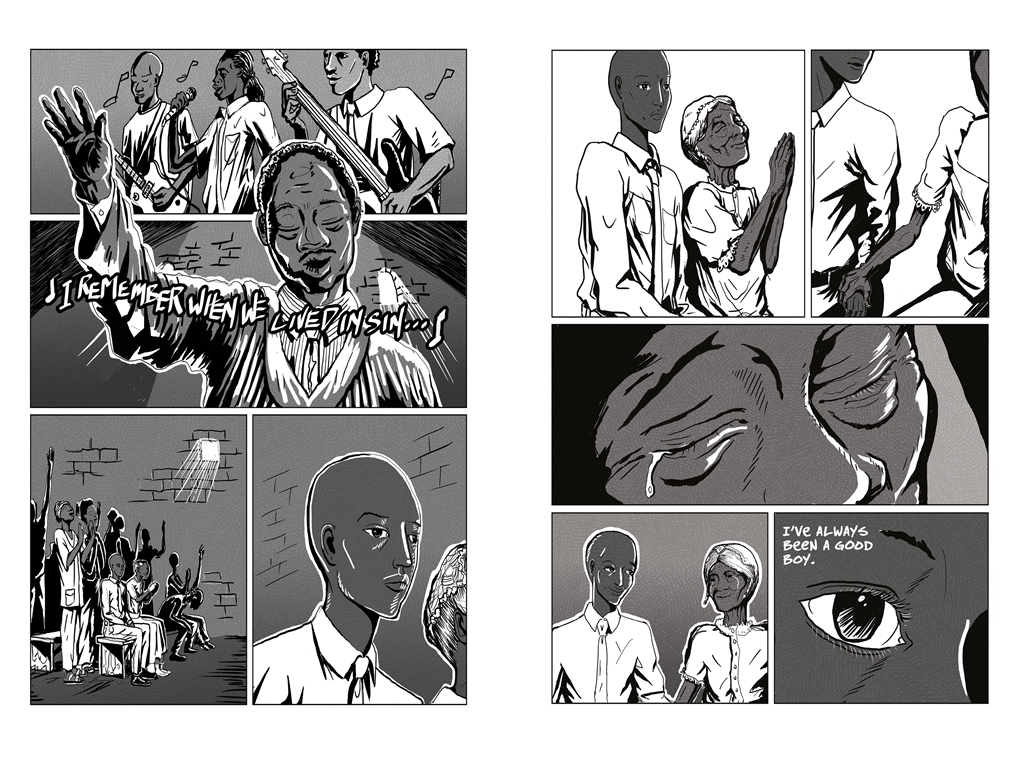
What makes the book especially powerful is the way it collapses distinctions between technological systems and spiritual systems. Williams refuses the idea that machinery exists separately from memory, ritual, grief, or myth. Throughout the novel, hacked networks resemble prayer circles. Data behaves like ancestral memory. Characters move through digital landscapes as though navigating sacred terrain. Even the book’s structure resists conventional narrative pacing, unfolding instead like a transmission interrupted by chants, visions, coded fragments, and moments of collective mourning.
This has always been Saul Williams’ particular brilliance. He approaches language less as exposition than vibration. His writing operates through rhythm, recurrence, invocation. Reading Martyr Loser King often feels closer to listening than decoding. Ideas echo across pages the way refrains echo through music. Images recur with altered meanings. Identity itself becomes unstable — stretched between flesh, circuitry, memory, and spirit.
Morgan Sorne’s artwork amplifies this instability beautifully. The visual world of the book feels simultaneously ancient and post-human, dense with collapsing architectures, wired bodies, ceremonial imagery, and landscapes overwhelmed by extraction and decay. The illustrations never simply accompany Williams’ ideas; they metabolize them. The result is a graphic novel that often feels less “read” than inhabited.
What lingers most after finishing Martyr Loser King is its refusal of emotional numbness. So much contemporary dystopian art mistakes detachment for intelligence. Williams rejects that entirely. Even at its bleakest, the book remains emotionally porous. It insists upon tenderness alongside rage, transcendence alongside political fury. The characters are not merely resisting systems of control; they are fighting to preserve the possibility of feeling fully human within systems specifically designed to fragment consciousness.
And that is where the book becomes more than cyberpunk, more than political allegory, more than speculative fiction. Williams is ultimately writing about spiritual survival under global capitalism — about what happens to the imagination when every aspect of human life becomes monetized, extracted, surveilled, and digitized. The real battle inside Martyr Loser King is not simply over resources or information. It is over perception itself. Over who gets to define reality. Over whose memories survive. Over whether communion remains possible inside systems built to isolate us from one another.
There is something deeply moving about Williams’ continued commitment to expansiveness in an era increasingly organized around exhaustion, cynicism, and collapse. He remains one of the few American artists still willing to approach liberation as both political and metaphysical. His work asks impossible things of the audience: to remain emotionally awake, spiritually open, intellectually restless. To resist becoming anesthetized by catastrophe.
In Saul Williams’ world, consciousness itself becomes a site of rebellion.
And rebellion, for him, is never quiet. It chants. It glitches. It mourns. It remembers.
 Publik / Private