The most compelling music often carries more than one history at a time. Jon Batiste’s Black Mozart (Batiste Piano Series, Vol. 2) is rooted in that understanding. Conceived as part of Batiste’s ongoing exploration of classical music through Black American musical traditions, the project asks what becomes possible when inherited categories are treated less as boundaries than as points of departure. Throughout the album, Mozart is not approached as a distant monument of European culture but as a musical interlocutor, someone whose work remains open to reinterpretation, improvisation, and dialogue.
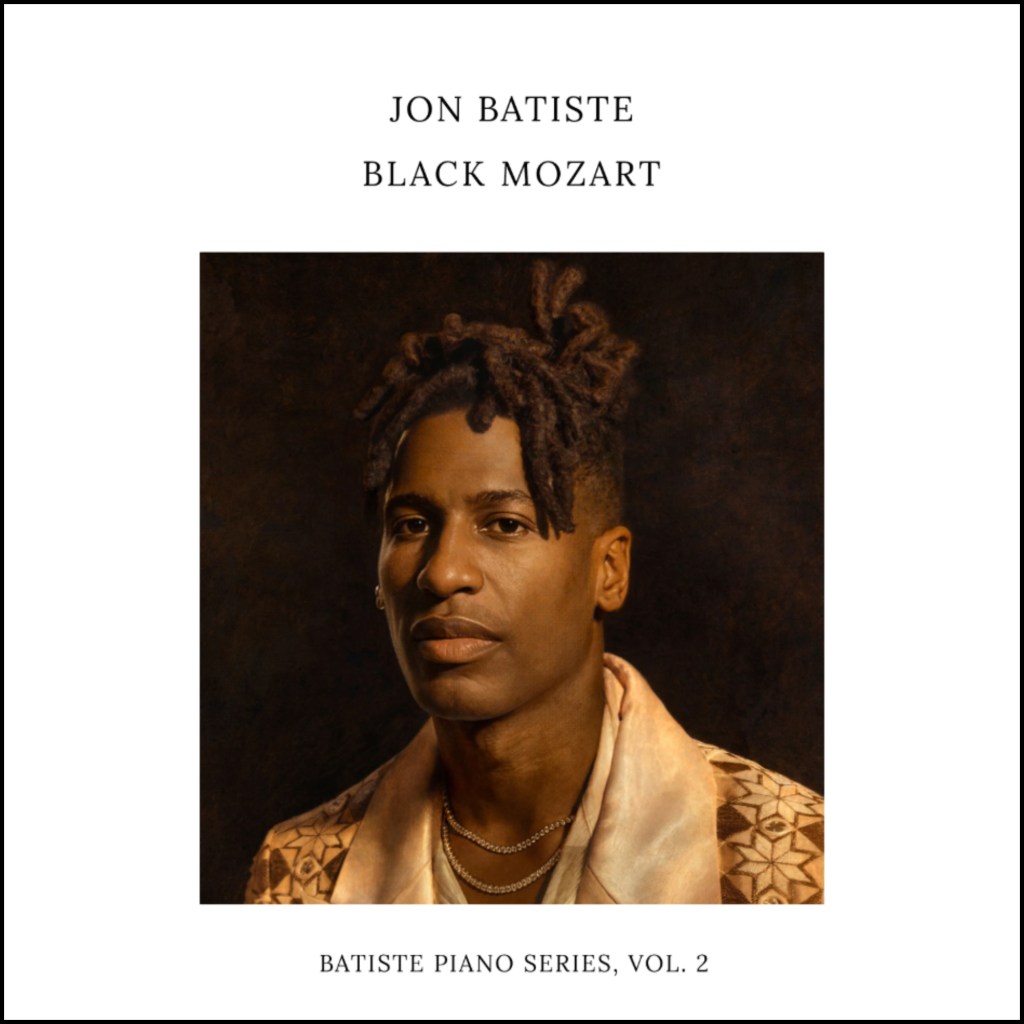
Among the album’s most intriguing titles is its closing piece, Gospel Andante. Even before a note is heard, the title suggests the larger concerns animating the project. “Andante,” one of classical music’s most familiar tempo markings, indicates movement at a walking pace. Gospel evokes an entirely different set of associations: the Black church, spiritual endurance, collective memory, testimony, grief, joy, and transcendence. Together, the words create a meeting point between traditions that have often been discussed as separate, despite centuries of overlap and exchange.
That meeting point feels particularly resonant in the context of Juneteenth.
The holiday commemorates June 19, 1865, when enslaved people in Galveston, Texas learned they were free more than two years after the Emancipation Proclamation. It is a celebration of liberation, but it is also a reminder of delay—of the distance between freedom declared and freedom experienced. Juneteenth asks Americans to reckon with the reality that history does not always move at the pace of justice. Information travels unevenly. Rights are often realized long after they are promised. Freedom itself is rarely a singular event. More often, it unfolds through a long process of recognition, struggle, adaptation, and collective remembrance.
The title Gospel Andante captures something of that historical rhythm. A gospel. A walk. A spiritual tradition grounded not only in belief but in movement. The pairing invites reflection on the ways Black communities have carried memory forward through music, creating cultural forms capable of holding contradiction without requiring resolution. Spirituals, blues, jazz, gospel, and countless other Black musical traditions emerged from conditions that demanded both endurance and imagination. These forms preserved history while simultaneously creating space for futures that had not yet arrived.
Batiste’s career has been shaped by a similar commitment to crossing perceived boundaries. Raised within a multigenerational New Orleans musical family and later trained at Juilliard, he has consistently moved between jazz, gospel, classical music, R&B, film scoring, and improvisational performance. Yet what distinguishes his work is not simply stylistic range. It is an insistence that these traditions are already connected. His projects often reveal relationships that institutional histories have obscured, placing Black musical innovation at the center rather than the margins of broader musical conversations.
That approach was central to Beethoven Blues, the first installment of the Batiste Piano Series. There, Batiste reimagined Beethoven through the languages of blues, gospel, stride piano, and improvisation. Black Mozart extends that inquiry, drawing connections between Mozart’s compositional imagination and the improvisational practices that have long animated Black American music. Batiste has spoken about Mozart and Thelonious Monk as artists who developed singular musical languages while absorbing influences from the worlds around them. The comparison is not intended to collapse historical differences but to highlight a shared commitment to invention.
What makes this framework compelling is that it arrives at a moment when conversations about classical music are increasingly concerned with questions of access, ownership, and representation. For decades, debates about diversity in classical music have often centered on who is permitted entry into the canon. Batiste’s work suggests a different line of inquiry. Rather than asking how Black artists fit into established musical histories, Black Mozart can be understood as asking how those histories change when Black musical traditions are recognized as integral to the story itself.
Not everyone will agree with that approach. Batiste’s reinterpretations of canonical composers have generated both enthusiasm and skepticism among listeners. Admirers hear an artist revitalizing familiar material through improvisation and cultural dialogue. Critics sometimes question whether such reinterpretations risk oversimplifying the complexities of either tradition. Yet the debate itself underscores the significance of the project. At stake is not merely the meaning of Mozart or Beethoven, but broader questions about who has the authority to reinterpret cultural inheritance and how musical traditions remain alive across generations.
In that sense, the significance of Gospel Andante extends beyond the title of a single composition. It becomes a lens through which to consider the larger project of cultural memory. Black music has long functioned as a site of preservation and transformation, carrying inherited knowledge forward while creating new forms of expression. Juneteenth operates similarly. The holiday asks each generation not only to remember the past but to reconsider what freedom requires in the present.
Freedom is often imagined as a destination, a completed achievement secured by law or proclamation. History tells a more complicated story. Freedom is also a practice of interpretation. A process of revisiting inherited narratives, recovering forgotten voices, and imagining possibilities that previous generations could not yet see. Music has always played a role in that work.
Whether considered as a composition, a title, or a symbolic gesture within Black Mozart, “Gospel Andante” points toward that ongoing conversation. It suggests that history is not a fixed monument but a living archive, one continually reshaped by those willing to engage it. On Juneteenth, that idea feels especially resonant. The story of freedom remains unfinished. So too does the story of music. Both continue to evolve through acts of listening, remembering, and reimagining what has been handed down.

