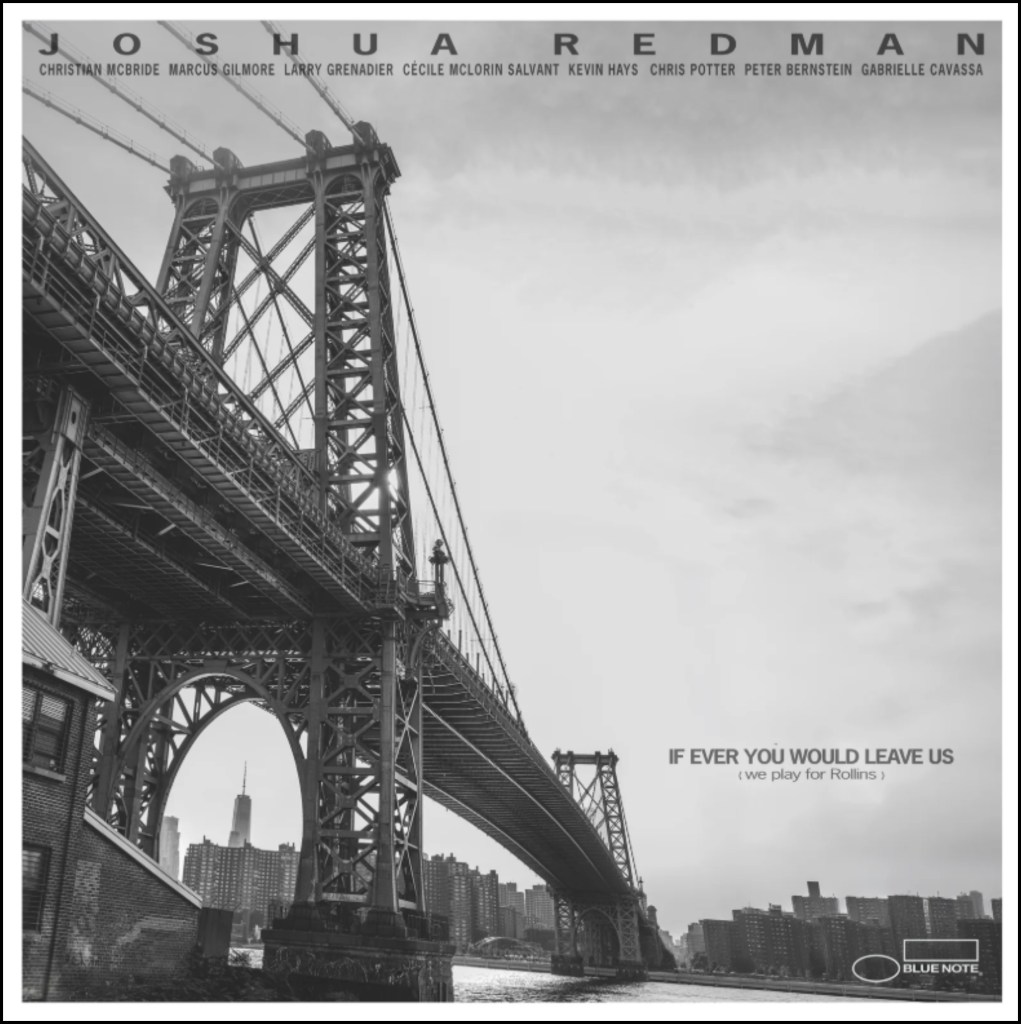
Influence can be a difficult thing to locate. Sometimes it lives in the obvious places—in the sound of an instrument, a phrase borrowed and transformed, a record repeatedly returned to. Other times it becomes so deeply embedded that it is difficult to separate the influence from the artist who received it. For Joshua Redman, Sonny Rollins is both. Redman discovered Saxophone Colossus at the Berkeley Public Library when he was around ten or eleven, an encounter he describes as his musical “eureka moment.” Rollins became his “gateway” into jazz improvisation and, eventually, his “North Star.”
If Ever You Would Leave Us (we play for Rollins), due November 20 on Blue Note, is Redman’s way of answering that influence after Rollins’s death earlier this year.
Redman learned of Rollins’s passing on May 25, 2026, while at home in Berkeley after celebrating his daughter’s sixteenth birthday. The next morning, he began calling musicians, unsure at first what the tribute would become but certain that he needed to make something. Within weeks, he had assembled a remarkable group in New York, including Christian McBride, Larry Grenadier, Marcus Gilmore, Kevin Hays, Peter Bernstein, Chris Potter, Cécile McLorin Salvant and Gabrielle Cavassa. The eleven selections draw from Rollins’s repertoire, but the album is not an attempt to recreate the past. Instead, Redman approaches Rollins the way Rollins approached the jazz tradition: by entering it, listening closely and then making it his own. Redman has described the sessions as feeling less like a funeral than an Irish wake, a fitting distinction for an album where grief and gratitude occupy the same space.
The Rollins connection becomes clearest in the album’s sound. Redman returns to the piano-less trio, one of Rollins’s defining formats, with bassist Christian McBride or Larry Grenadier and drummer Marcus Gilmore. It is a configuration Redman has explored throughout his career, most explicitly on 2007’s Back East, but here it carries the weight of direct remembrance. “The Last Time I Saw Paris,” for example, is recast in 5/4, while “Pent-Up House” moves mostly through seven and “Valse Hot” through eleven. These rhythmic choices are not exercises in complexity for their own sake; Redman has said the odd meters have to feel physical, even danceable. That physicality is essential to understanding why Rollins remains such a powerful presence in Redman’s playing: the tribute is not simply to Rollins’s compositions, but to his way of turning structure into freedom.
The repertoire also reveals how carefully Redman has chosen to converse with Rollins rather than simply celebrate him. The album opens with a solo “There Will Never Be Another You,” inspired by Rollins’s 1959 trio performance in Sweden, before moving through “Doxy,” “Blue Seven,” “Grand Street,” “God Bless the Child” and “Don’t Stop the Carnival.” On “Blue Seven,” Redman meets another tenor virtuoso, Chris Potter, while “Grand Street” features guitarist Peter Bernstein, a veteran of Rollins’s band. Cécile McLorin Salvant joins Redman for “Softly, As in a Morning Sunrise,” another nod to Rollins’s celebrated piano-less trio recordings. The effect is less like looking at a photograph of Rollins than watching his ideas move through a new generation of musicians.
“God Bless the Child” makes that inheritance especially poignant. Rollins recorded the Billie Holiday standard on The Bridge, his landmark 1962 return to recording, and Redman deliberately follows Rollins’s arrangement here, with Gabrielle Cavassa carrying the melody while Redman supports her. Rollins had been interpreting a song associated with Holiday; Redman is now interpreting Rollins interpreting Holiday. Redman calls it “a tribute to a tribute,” and the phrase captures the album’s deeper logic. Jazz history rarely moves in a straight line, because every musician receives something already transformed by someone else. What Redman offers Rollins is another transformation, one that acknowledges the past precisely by refusing to leave it untouched.
There is something particularly moving about the fact that Redman’s relationship with Rollins predates his professional life by decades. When Redman was fifteen, his mother sent recordings of his playing to his father, the saxophonist Dewey Redman, who eventually told him, “You sound good. You sound like Sonny Rollins.” The comment became part of a complicated musical inheritance: a father recognizing his son through the sound of another saxophonist. Redman would eventually develop a voice unmistakably his own, but Rollins remained present as a model for curiosity, discipline and reinvention. Now, after Rollins’s death, Redman has returned to that original source and found Redman is not trying to preserve Sonny Rollins in amber; he is demonstrating what it means for an artist’s influence to remain alive. Rollins’s compositions become vehicles for new rhythms, new voices and new conversations, while the musicians themselves carry pieces of his history into the present in another way to listen.
That is ultimately what makes If Ever You Would Leave Us more than a tribute album. Redman is not trying to preserve Sonny Rollins in amber; he is demonstrating what it means for an artist’s influence to remain alive. Rollins’s compositions become vehicles for new rhythms, new voices and new conversations, while the musicians themselves carry pieces of his history into the present. The album’s title suggests absence, but its music argues for continuity. Rollins may have left the physical world, yet the questions he asked through improvisation remain available to anyone willing to listen closely enough. Redman’s answer is simple and deeply musical: play the songs, change them, and keep going.
If Ever You Would Leave Us (we play for Rollins)
Tracklist
1. There Will Never Be Another You
2. Doxy
3. The Last Time I Saw Paris
4. Pent-Up House
5. Softly, As In A Morning Sunrise
6. If Ever I Would Leave You
7. Blue Seven
8. Valse Hot
9. Grand Street
10. God Bless The Child
11. Don’t Stop The Carnival
Personnel
Joshua Redman – Saxophone
Christian McBride – Bass
Larry Grenadier – Bass
Marcus Gilmore – Drums
Special Guests:
Kevin Hays – Piano
Peter Bernstein – Guitar
Chris Potter – Saxophone
Cécile McLorin Salvant – Vocals
Gabrielle Cavassa – Vocals

