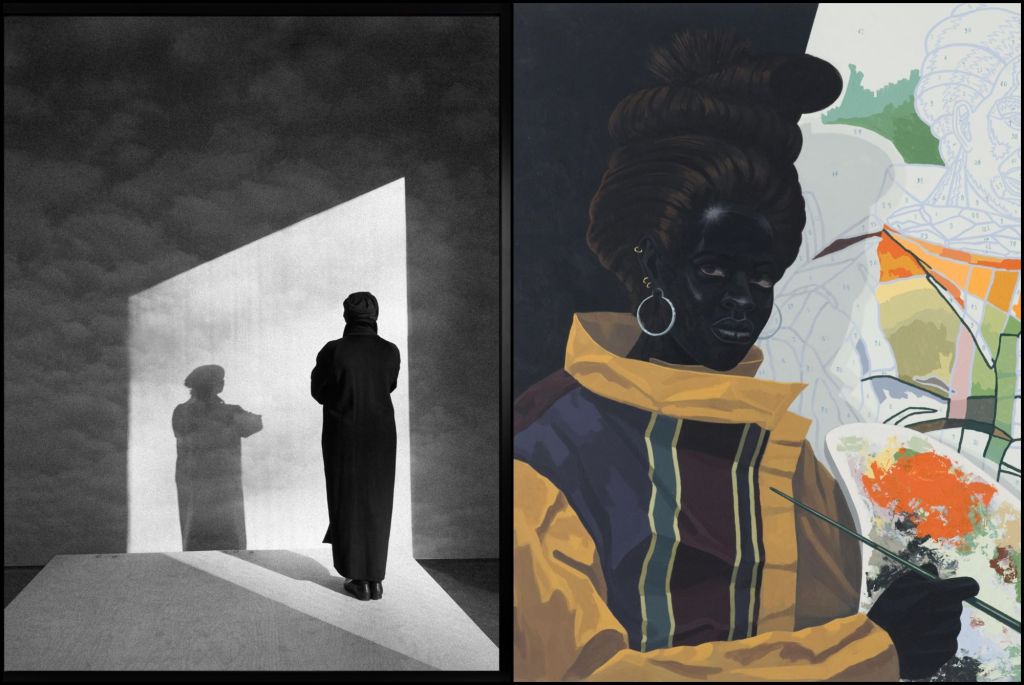
Weems and Marshall
There is a particular kind of insistence in the work of and —a refusal not just to be overlooked, but to accept the inherited terms of visibility. Their practices do not simply add to the canon; they interrogate and reconfigure the conditions under which Black life is made visible at all.
Weems begins in the intimate. A table, a gesture, a body caught in the act of considering itself. In The Kitchen Table Series, she constructs scenes that feel familiar but are carefully staged, using photography less as evidence and more as a site of questioning. Text often accompanies her images, not as caption but as counterpoint, complicating what is seen. For Weems, the photograph is never a passive record; it is an active participant in shaping meaning. Her work insists that images carry bias, intention, and history within them.
Marshall, by contrast, works outward from scale and saturation. His paintings are expansive, filled with color, detail, and a deliberate engagement with the traditions of Western art. Where Black figures have historically been excluded or minimized, he places them at the center—fully realized, fully present. His use of deeply dark, almost absolute black tones for skin is not incidental; it is a deliberate strategy, emphasizing visibility through contrast and asserting a presence that cannot be diluted or ignored.
Both artists are deeply concerned with power, but they approach it differently.
Weems circles power as a subject, returning to it through multiple forms—photography, installation, text, and video. Her work examines how power operates through images, through history, and through systems of representation. She draws from archival material and recontextualizes it, exposing the ways in which visual culture has been used to construct and control narratives about race and identity. In works like From Here I Saw What Happened and I Cried, she reclaims historical photographs and overlays them with text, shifting their meaning and forcing a confrontation with their origins.
Marshall engages power through structure. He adopts the formal language of Western painting—composition, perspective, allegory—and uses it to build new narratives. His work does not reject tradition outright; instead, it enters into it and reshapes it from within. By placing Black figures into scenes of leisure, beauty, and everyday life, he challenges the narrow range of representation historically afforded to them. His focus is not on trauma as the defining experience, but on presence—on the fullness of being.
This marks a key divergence in their philosophies.
Weems approaches the image as something to be examined and questioned. Her aesthetic often leans toward restraint: controlled compositions, limited color palettes, and a pacing that encourages reflection. She is less interested in resolving the tensions she exposes than in making them visible.
Marshall, on the other hand, is invested in building. His paintings are rich with references—from European art history to popular culture—and they operate as acts of reconstruction. Rather than dismantling the image, he expands it, creating spaces where Black life is not marginal but central, not exceptional but ordinary and expansive at once.
Their differences are also shaped by the contexts in which they emerged.
Weems’s work reflects a late 20th-century moment deeply influenced by postmodern thought—a skepticism toward images, archives, and dominant narratives. Her practice is rooted in questioning authority: who creates images, who controls them, and whose stories are told.
Marshall, while equally aware of these questions, moves toward a different task. Accepting the critique as a starting point, he turns toward creation—toward filling the gaps that have been exposed. His work envisions a more complete narrative within the history of painting, one in which Black figures are integral rather than absent.
Their approaches to time further illuminate this distinction.
Weems compresses time, bringing past and present into direct conversation. Historical images are not treated as distant artifacts but as active elements in contemporary life. Her work suggests that history is ongoing, that its effects persist and must be continually addressed.
Marshall extends time, inserting Black figures into historical frameworks from which they were excluded. His paintings operate almost as revisions of art history, proposing alternate continuities and possibilities. In doing so, he does not simply critique the past; he rewrites its visual record.
The body, too, functions differently in their work.
In Weems’s practice, the body is often personal, sometimes her own, and always situated within a network of relationships and power dynamics. It is a site of inquiry, a means of exploring identity and perception. Her figures frequently engage in acts of looking—into mirrors, at one another, or outward toward the viewer—creating a layered experience of observation.
In Marshall’s paintings, the body is stylized and commanding. His figures occupy space with confidence, often rendered with a sense of theatrical presence. They do not seek recognition; they assume it. Their scale and composure transform them into agents rather than subjects of representation.
And yet, despite these differences, their work is deeply connected.
Both artists are invested in redefining visibility—not as simple inclusion, but as a shift in how images function and what they allow. Weems teaches us to question what we see, to recognize the constructed nature of images and the histories they carry. Marshall pushes further, asking what new images might look like if those histories were rewritten.
Together, their practices form a continuum: one that moves from critique to creation, from interrogation to expansion. Between them, a new visual language takes shape—one that does not accept absence, does not settle for partial representation, and does not relinquish control over how Black life is seen.
It remains present, insistent, and unresolved in the best possible way.

