Written by Jordannah Elizabeth Graham-Mayer
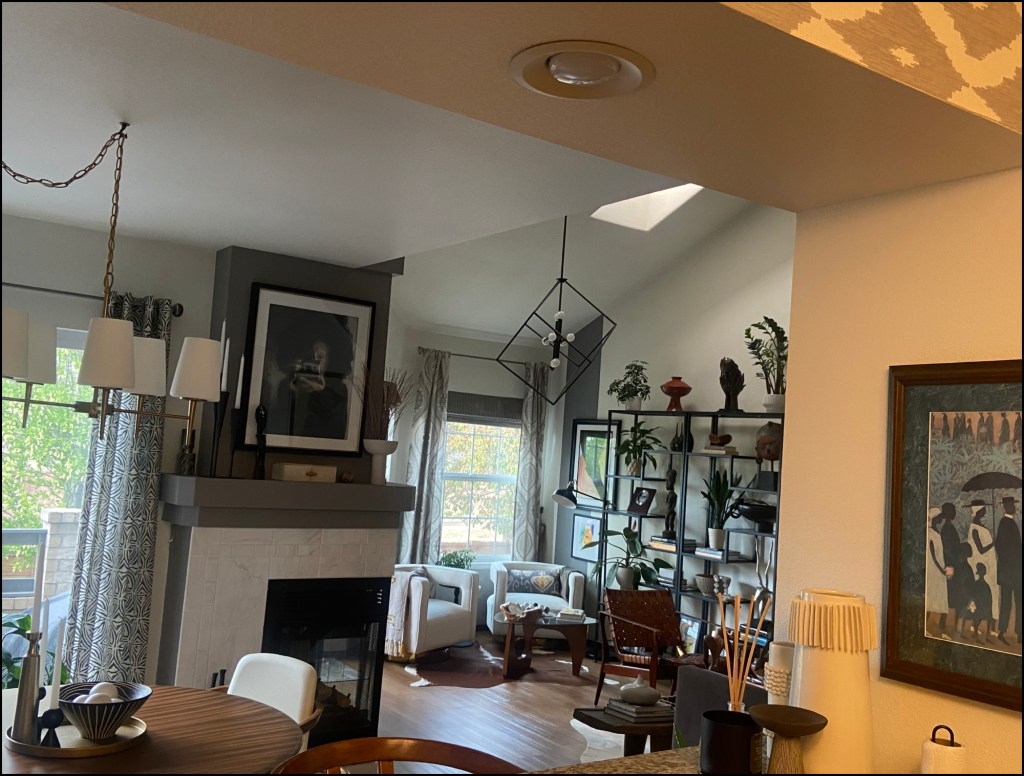
Image above: Our home. Simple, and sunlit.
There are mornings when the house feels like a held note.
Not silence exactly—never silence—but the kind of quiet that has texture. Wood settling in the floorboards. Water beginning its run through old pipes. A kettle thinking about becoming steam. Somewhere in another room, fingers brushing strings not to perform, not to prove anything, but simply to ask the day what shape it intends to take.
Marriage, I’ve learned, is less thunderclap than weather.
I think many people imagine love at its most convincing when it is dramatic: declarations made under impossible skies, doors flung open, tears timed perfectly to the chorus. But the real force of it, the kind that changes the architecture of a life, is usually smaller and stranger. It is someone remembering how you take your coffee after pretending for years not to care about coffee. It is learning the difference between the sigh that means fatigue and the sigh that means grief. It is discovering that tenderness can be logistical. That devotion sometimes looks like replacing batteries, warming soup, answering the phone when the world feels too loud.
To love someone known by many is to become intimate with the distance between public light and private shadow. People think recognition reveals a person. Often it only magnifies the outline. Fame can turn a human being into a symbol, and symbols are notoriously difficult to hold. They do not snore, forget appointments, lose their patience, laugh at inappropriate moments, stand barefoot in the kitchen eating fruit over the sink. They do not ask, quietly, if they are enough.
But a husband does.
And a wife, if she is honest, does too.
There is a particular humility in being loved where you are least edited. No applause in it. No flattering camera angle. No audience to mistake attention for understanding. Just the daily invitation to be seen accurately and remain anyway. I used to think romance lived in mystery. Now I suspect it lives in witness.
We are all multiple people across a lifetime. The self who survives youth is not the self who enters marriage. The self who enters marriage is not the self who learns loss, or steadiness, or how to apologize without defending the bruise. Love asks us to keep meeting each other after every revision. To say, again and again, hello to the person standing where someone familiar used to be.
This is not effortless work. Anything alive resists simplification.
There are days one of us is radiant and the other cannot find the thread of themselves. Days one of us speaks in whole paragraphs while the other can only offer weather reports and nods. Days old wounds sneak into new rooms wearing fresh clothes. Yet there is mercy in being known long enough for someone to recognize the wound before they recognize the performance around it.
Some evenings I watch him become quiet in the way artists sometimes do—as if listening for footsteps only they can hear. The world tends to romanticize that solitude. It can be beautiful, yes. It can also be lonely. Loving a creative mind means understanding that sometimes retreat is not rejection. Sometimes distance is labor. Sometimes the closed door is a workshop, not a wall.
And still, eventually, the door opens.
He returns carrying some fragment of melody or thought, and I return carrying whatever I have gathered from my own invisible fields, and we place our findings on the table like two people who have been to different countries but share an address.
This, perhaps, is the secret no one sells: marriage is not the merging of identities but the sheltering of two separate interior lives beside one another. It is not vanishing into “us.” It is building an “us” spacious enough for two names, two callings, two silences, two sets of ghosts.
There is glamour nowhere near this truth, which may be why it matters so much.
I do not mean to suggest some polished serenity. We are human. We misread tones. We interrupt. We carry moods home like burrs in our clothing. We fail each other in ordinary ways. But over time, love becomes less about never wounding and more about how faithfully you return with balm. Less about perfection than repair.
I have come to cherish the unspectacular evidence: the extra blanket folded at the foot of the bed because I always get cold before admitting it. The text with no content except Drive safe. The hand finding the small of my back in a crowded room as if to say, without performance, Still here.
Still here may be the most romantic phrase in any language.
Not because it promises forever in the abstract, but because it chooses presence in the concrete. Here, where dishes wait. Here, where bodies age. Here, where fear occasionally visits and joy rarely announces itself before arriving. Here, where love must compete with schedules, ego, memory, fatigue, ambition, laundry, headlines, grief.
Here.
There are mornings when the house feels like a held note. The kettle exhales. Light slips across the floor. Somewhere in another room, a guitar wonders itself awake. I move toward the sound not because it is famous, not because it is beautiful, though it is, but because it is familiar to me now in the holiest sense of the word.
It belongs to the life we have made.
And so, quietly, I answer.

