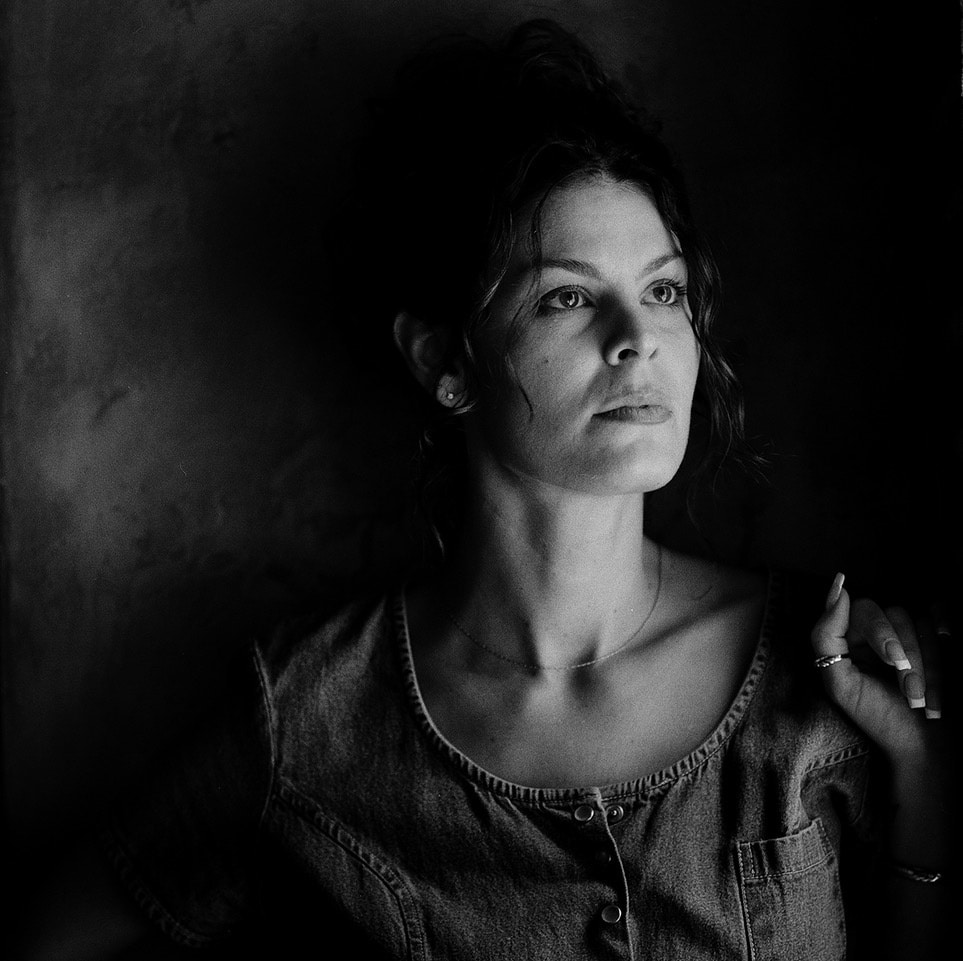
Gabrielle Cavassa: Roxy Hotel, NYC, 2025. Photo copyright William Ellis
Jazz is a traveler. It crossed the Atlantic almost as quickly as it crossed America, finding unlikely homes in Paris cafés, Sicilian piazzas, Roman cinemas, and Milanese jazz clubs. Italian musicians embraced the music not as imitation but as conversation, hearing in its improvisatory spirit echoes of opera, folk song, and the canzone italiana—a tradition where melody is expected to carry memory as much as beauty. Somewhere between Naples and New Orleans, between Verdi’s dramatic lyricism and the harmonic openness of modern jazz, lies the emotional terrain that Gabrielle Cavassa inhabits.
That landscape gives Diavola its quiet complexity.
The album’s emotional vocabulary owes as much to the Italian canzone as it does to the American jazz standard. Both traditions understand that interpretation is an act of authorship—that every generation must discover a song anew. Cavassa moves effortlessly between those worlds, never announcing where one ends and the other begins. The result is neither crossover nor fusion. It is something more organic: a musical identity in which heritage is not performed but absorbed, where ancestry becomes less a subject than a sensibility.
Co-produced by Joshua Redman and Blue Note president Don Was, Diavola reflects the label at its most discerning, placing its faith in artists who deepen tradition through interpretation rather than reinvention for its own sake. Under Was’s stewardship, Blue Note has increasingly become a home for musicians who understand that jazz evolves not by abandoning its history, but by listening to it differently. Cavassa’s debut belongs naturally within that lineage. Diavola is remarkable for its confidence in understatement. Her voice arrives almost conversationally, often leaning just behind the beat, allowing a phrase to unfurl with the unhurried logic of an improviser. She sings less like a vocalist commanding the room than like another instrumental voice within the ensemble, shaping melody with the patience of a horn player.
Jeff Parker’s original guitar composition, “Heaven Sighs,” opens Diavola on its own. Cavassa doesn’t sing until the second track, a beautifully understated reinterpretation of “Raindrops Keep Falling on My Head.” Parker’s spacious guitar, Brian Blade’s understated pulse, Larry Grenadier’s resonant bass, and Paul Cornish’s luminous piano offer the best risk a musical can project: not surrounding everything with themselves, but being generous with collaboration.
By the time Cavassa enters, she isn’t arriving to lead the band so much as joining a conversation already in progress. That opening sequence reveals the album’s central aesthetic: restraint over display, interplay over spotlight, and the quiet confidence to let the music unfold on its own terms. Her reading of “Raindrops Keep Falling on My Head” uncovers a wistfulness beneath the song’s familiar optimism, while “Prisoner of Love” unfolds with such quiet patience that its well-worn lyric feels newly intimate. Even “Could It Be Magic” is liberated from its theatrical origins, revealing an unexpectedly fragile heart beneath the pop architecture.
Her original songs deepen that conversation. “Bossy Nova” balances sly humor with rhythmic sophistication, while the title track becomes the album’s emotional axis—not because it explains its contradictions, but because it inhabits them. Throughout, Brian Blade’s painterly drumming, Larry Grenadier’s resonant bass, Paul Cornish’s luminous piano, Jeff Parker’s spacious guitar, and Redman’s understated tenor create an ensemble that listens as deeply as it plays. No one reaches for the spotlight. Every gesture serves the song.
That generosity may be Cavassa’s greatest gift. She approaches every melody—whether American standard, Italian ballad or original composition—as though it were being sung for the first time. Heritage is not something she performs; it is something she hears. In her voice, the lyric intimacy of the canzone italiana and the harmonic openness of modern jazz become inseparable, creating a sound that feels at once deeply rooted and entirely her own.
Perhaps that is the quiet triumph of Diavola. It reminds us that jazz has never belonged to one place, but to those willing to carry it forward. Cavassa does not ask where jazz ends and Italian song begins. She lets them breathe in the same phrase, until the distinction no longer matters.

