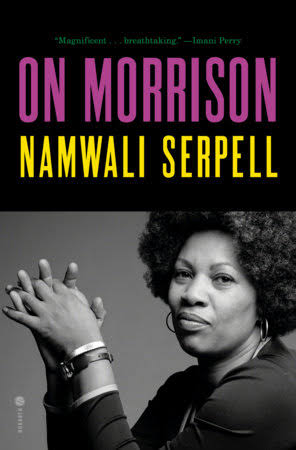
There is a distinct kind of responsibility that arrives when one artist writes seriously about another.
Admiration alone is not enough. Distance can become its own form of misunderstanding, especially when an artist has reached the level of cultural recognition that surrounds Toni Morrison. The larger an artist’s legacy becomes, the easier it can be to discuss the meaning of the work without fully returning to the work itself. The person becomes an icon. The books become landmarks. The conversation begins orbiting around importance rather than returning to the creative decisions that made the work important in the first place.
Namwali Serpell’s On Morrison is a remarkable act of return.
Published by Hogarth, On Morrison is not a biography or a traditional introduction to Morrison’s life. It is a work of literary criticism by Serpell, an award-winning novelist, essayist, and professor of English, that examines Morrison’s fiction, nonfiction, plays, and poetry through sustained close reading and critical engagement. The book approaches Morrison not as a finished monument, but as an artist whose methods, structures, and imaginative decisions continue to demand attention. This distinction is what makes the book so compelling. Serpell is not asking readers only to remember why Morrison matters. She is asking readers to examine how Morrison works. The question becomes one of craft.
How does a writer construct memory? How does a novel hold history without becoming only a historical document? How can language represent experiences that have often been ignored, distorted, or simplified? How does an artist create characters who are shaped by the worlds around them while remaining fully human, contradictory, imaginative, and alive?
These questions have always been central to Morrison’s work, but Serpell’s contribution is the precision with which she examines the artistic mechanisms behind them. Across discussions of Morrison’s novels—including The Bluest Eye, Sula, Song of Solomon, Tar Baby, Beloved, Jazz, Paradise, and others—as well as her short story “Recitatif,” criticism, plays, and poetry, Serpell considers the formal choices that make Morrison’s writing so distinctive. She examines the architecture of Morrison’s narratives: the movement of time, the use of language, the relationship between absence and meaning, and the ways Morrison created new possibilities for the novel. In this sense, On Morrison is also a book about reading itself.
Morrison’s novels have often been discussed through the enormous cultural questions they engage: race, gender, memory, violence, family, history, and identity. Those conversations are necessary, but Serpell reminds us that Morrison’s genius also exists in the ways those ideas are transformed into artistic form. The structure of a novel is not separate from its meaning. The rhythm of a sentence is not separate from its emotional impact. The choices a writer makes about perspective, silence, repetition, and time become part of the story being told. This is one of the greatest gifts criticism can offer: it can return our attention to the decisions.
Every creative work contains a hidden record of choices. A song contains decisions about arrangement, repetition, silence, and movement. A painting contains decisions about space, perspective, and composition. A novel contains decisions about whose voice enters first, what information is withheld, what memories return, and what remains unresolved. Serpell approaches Morrison with attention to those decisions which makes attention feels especially meaningful because Morrison’s public image has sometimes become inseparable from her stature. She is rightfully recognized as one of the most significant American writers of the twentieth century, a Nobel Prize-winning author whose work transformed literary conversations around storytelling, history, and representation. Yet the danger of monumentalizing an artist is that monuments are often viewed from a distance. They are admired, but they are not always examined, and Serpell brings Morrison closer. She restores movement to the work.
One of the most fascinating aspects of On Morrison is that it does not treat Morrison’s complexity as something that needs to be overcome. Instead, Serpell examines complexity as part of Morrison’s artistic language. Morrison’s writing asks readers to participate. It does not offer easy conclusions because human experience rarely arrives in simple arrangements. Meaning develops through accumulation, through relationships between moments, through the gradual recognition that what appears unresolved may actually be revealing a deeper truth. This is why Morrison’s work continues to evolve alongside its readers.
A work of art is never encountered in exactly the same way twice because the person encountering it is never exactly the same person. Experience alters interpretation. Time alters understanding. A passage that once seemed distant can become suddenly intimate. A character’s choices can appear differently after years of living, loving, losing, and learning, and Serpell understands the relationship between time and interpretation.
She writes as both a scholar and a novelist, bringing together analytical rigor with the imaginative awareness of someone who understands the creative process from within. Her engagement with Morrison is not a distant observation. It is a conversation between writers, between generations, and between different ways of understanding what literature can accomplish. This is where On Morrison becomes larger than a book about one writer, and the book becomes more about artistic inheritance.
Every generation of artists receives something from those who came before. Sometimes it is a form. Sometimes it is a technique. Sometimes it is simply the knowledge that certain possibilities exist because someone else had the courage to imagine them first.
Morrison expanded the possibilities of the novel. Serpell expands the possibilities of how we encounter Morrison.
That exchange is what makes the book so valuable. It does not ask readers to place Morrison at a greater distance. It asks them to come closer—to examine the work with renewed curiosity, patience, and respect for the complexity that made it endure. The best criticism does not close a conversation, it deepens one.
On Morrison succeeds because Serpell understands that returning to a great artist is not an act of repetition. It is an act of discovery. The work remains alive because it continues offering new questions, new connections, and new ways of understanding the relationship between art and human experience.
Namwali Serpell’s On Morrison is a reminder that seeing deeply is its own creative act.
 Publik / Private