Written by: Jordannah Elizabeth Graham-Mayer
PRELUDE
The thought of a young man singing ‘…the love I give, return to me’. I hope the cyclical and linear movement of the years of quiet moments: a kiss on the forehead in San Francisco, or seeing him ride past on a bike 15 years later in NoHo, with no cameras, with our family, with Aubrey as his friend, and now a past era for me. 30 years, and we’ve all been quiet about it, and yet, as real and present as can be. John’s been here. I was reading cards and got to thinking:
STILL HERE
There are evenings when the world feels too loud for certainty, and too quiet for distraction. Late one Monday, long after the day’s obligations had dissolved into the familiar stillness of home, I found myself reaching for a deck of tarot cards—not because I needed answers, but because I wanted a different way of asking questions. Marriage has a way of teaching you that the most important truths rarely arrive as revelations. They emerge gradually, through symbols, memories, rituals, and conversations that continue unfolding over years. As I shuffled the deck, I wondered less about the future than about time itself: how love begins, how it changes, and what remains when two people have lived enough life to know that devotion is built far more often than it is found.
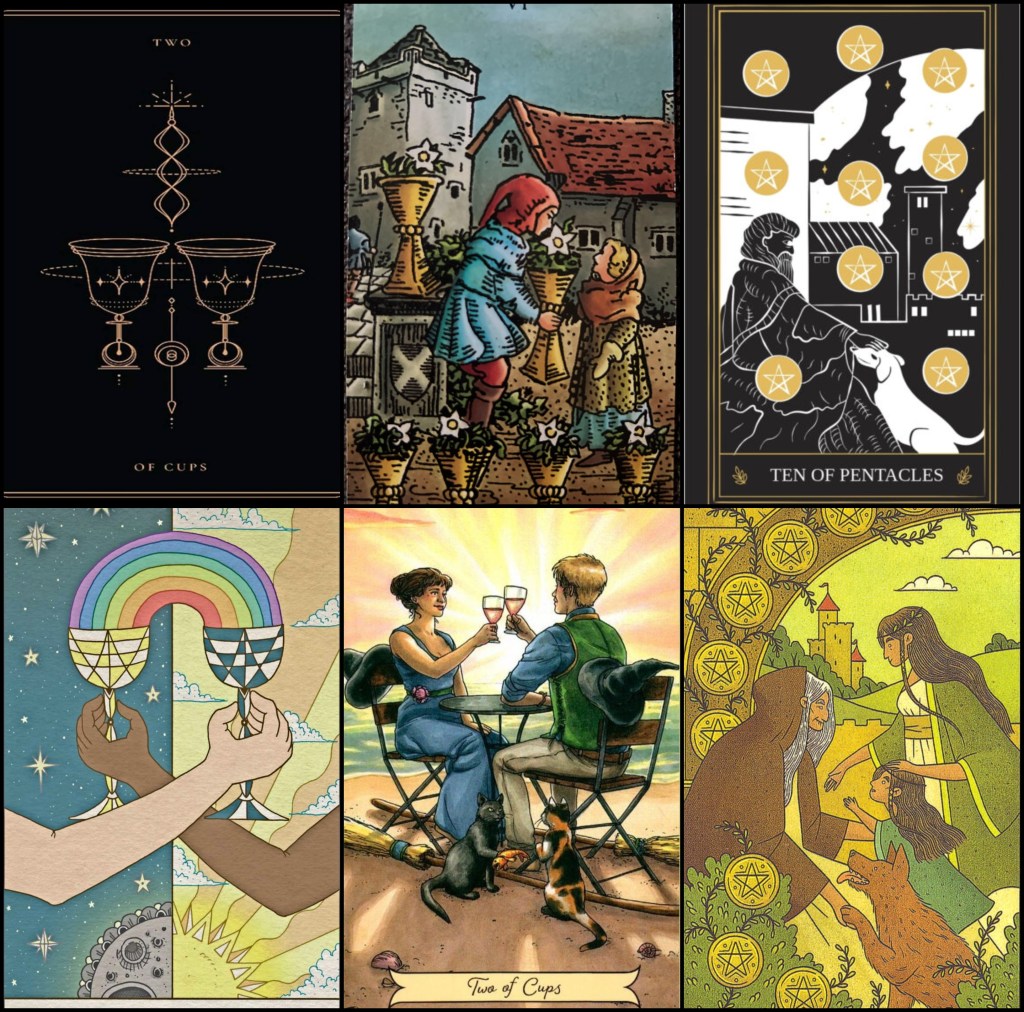
The cards appeared with unusual clarity. The Six of Cups arrived first, followed by the Ten of Pentacles, as though the reading itself had decided to tell a story stretched across an entire lifetime. Between them came the Two of Cups, the King of Pentacles, and the Six of Pentacles—less like interruptions than milestones along a road I recognized immediately. Together they seemed to describe the whole arc of a marriage: from childhood recognition to mature partnership, from first affection to lasting stewardship, from the innocence of beginnings to the quiet abundance of a life patiently built together. Looking at them spread across the table, I realized they were not predicting anything at all. They were inviting me to consider the remarkable distance between who we are when we first meet someone and who we become after a lifetime of choosing one another.
There is a peculiar kind of love that cannot be measured by anniversaries because it predates the calendar itself. It begins before either person understands what permanence is, before either has language for devotion or the architecture of a shared life. We often speak about marriages by counting years, but there are relationships that ask to be counted differently. They ask us to remember the first conversation, the first recognition, the first inexplicable certainty that another person would somehow continue appearing at the edges of your life long before either of you knew why.
The Six of Cups has always seemed less sentimental to me than people imagine. It is not simply about childhood or innocence. It is about memory refusing to become obsolete. It asks what survives after ambition, after disappointment, after distance has had every opportunity to erase what came before. Children do not love because they have calculated compatibility. They love because recognition precedes explanation. There is a generosity to childhood that adulthood often mistakes for naïveté, when it is, in fact, a remarkable confidence in the future.
I sometimes think the greatest miracle is not that two people remain together after decades. It is that they remember who the other was before either became who the world demanded them to be.
John and I have lived enough life to understand how easily identities accumulate. Careers become biographies. Headlines become shorthand. Accomplishments begin introducing us before we have the chance to introduce ourselves. People speak about public lives as though they are complete portraits, but marriage quietly insists on a different archive. It remembers the unfinished versions of us. It keeps photographs no newspaper could publish because they exist only in memory. It remembers the children who had no idea what adulthood would require of them.
There is something profoundly comforting about being known from the beginning. Not because it eliminates mystery, but because it provides context for every transformation that follows. The person who knew your first questions is often the only one capable of appreciating your final answers.
The Ten of Pentacles has never struck me as a card about wealth. It is about inheritance. Not merely the inheritance we receive, but the inheritance we create for others through constancy. Its abundance is measured in continuity rather than accumulation. It imagines a table where generations gather, where stories become traditions, where love survives the personalities that first carried it into the room.
Marriage, at its best, resembles that table.
It asks two people to become reliable enough that their affection begins sheltering more than themselves. Over time, love develops infrastructure. It becomes routines, shared vocabulary, familiar silences, children, friendships, obligations, laughter remembered before it happens again. What began as attraction matures into stewardship. The relationship no longer belongs exclusively to the couple who created it. It becomes part of a family’s emotional geography.
Perhaps that is why the distance between the Six of Cups and the Ten of Pentacles feels less like a journey than a conversation sustained over decades.
The beginning and the ending recognize each other.
The Two of Cups appeared first among the cards that bridged those two larger archetypes, reminding me that every lasting partnership begins with mutual recognition rather than possession. Beside it stood the King of Pentacles—not as an emblem of material success, but as a figure of steadiness, someone who understands that providing stability is one of love’s most understated forms of romance. Then came the Six of Pentacles, its gentle lesson about reciprocity lingering longer than I expected. Love cannot remain healthy if generosity only travels in one direction. It asks each partner, over and over again, to become both giver and receiver without allowing pride to interfere with either role.
It struck me that these cards did not interrupt the story told by the Six of Cups and the Ten of Pentacles. They explained the years between them:
Recognition.
Steadiness.
Reciprocity.
Those are not dramatic words, but marriages are rarely sustained by drama. They are sustained by habits that become virtues almost accidentally. A hand reached across a room without thinking. A conversation resumed after months because neither person believed it had truly ended. Forgiveness offered before resentment had the chance to settle into permanence. Choosing each other so many ordinary times that the extraordinary eventually grows out of the ordinary almost unnoticed.
People often imagine enduring love as something cinematic, but I have come to believe its greatest beauty is agricultural.
It is cultivated.
You return to the same field year after year, discovering that care accumulates more quietly than excitement but far more reliably. Seasons change. Storms arrive. Harvests vary. Yet the land remembers every season it has survived. So do people.
Looking backward no longer feels like nostalgia to me. It feels like gratitude. Childhood offered the impossible optimism of believing life would eventually make sense. Adulthood has offered something better. It has taught me that meaning is rarely discovered all at once. It is assembled patiently through ordinary days spent beside someone willing to keep building long after novelty has disappeared.
The Six of Cups teaches us where love begins.
The Two of Cups reminds us why it begins.
The King and Six of Pentacles teach us how it survives.
And the Ten of Pentacles, waiting patiently at the far end of the table, reminds us that the truest measure of a marriage is not how brilliantly it starts, but how completely it becomes a home in time.

