Written By: Jordannah Elizabeth Graham-Mayer
A writer’s life is made not only from the books she publishes but from the things she cannot stop noticing—the gestures that become characters, the histories that refuse to stay buried, the sentences of other writers that follow her for decades, the private questions that become public art, and the persistent feeling that the world, despite everything we think we know about it, remains stranger than our explanations for it.
Zadie Smith and Namwali Serpell have built their literary lives inside that strangeness, though they approach it from different directions and with markedly different formal instincts, and what makes their work so compelling together is not that they offer parallel versions of the Black woman writer but that neither is satisfied with the category as an endpoint. Smith has spent twenty-five years testing the possibilities of the novel, essay, play, short story, and cultural criticism, while Serpell has moved with unusual ease between fiction, scholarship, criticism, and the classroom, treating each form as another instrument for examining the instability of human knowledge. Smith’s career began with the enormous public arrival of White Teeth and the strange burden of becoming a literary phenomenon in one’s twenties; Serpell’s emerged through the slower, more intellectually hybrid path of the scholar-writer whose first novel could contain nearly two centuries of Zambian history, speculative technology, family mythology, colonial inheritance, and a chorus of mosquitoes. What links them is not simply achievement but a particular faith in difficulty: the belief that a serious work of literature should be allowed to exceed the explanation we might give for it. Their books ask us to stay with contradiction long enough for contradiction to become knowledge.
Smith’s early reputation was built around exuberance, and White Teeth deserved its exuberance: the novel’s London is crowded with immigrant histories, religious commitments, family resentments, racial identities, accidents of birth, political convictions, and the comedy that erupts when people discover that the lives they have inherited are not the lives they imagined for themselves. Yet the novel’s importance becomes clearer when read backward from Smith’s later work, because what initially looked like a celebration of multicultural possibility also contained a suspicion of the stories people tell about multiculturalism. Smith has always understood that identity is both deeply felt and partially constructed, something inherited and performed, something intimate and political at the same time. Her characters frequently believe that if they can explain where they came from they will understand who they are, only to discover that history has a way of becoming more complicated once it enters the body. This is one of Smith’s great gifts: she can make sociology feel like drama without turning characters into sociological examples. Her people remain messy, funny, vain, tender, deluded, intelligent, and occasionally ridiculous, which is precisely why the larger structures around them become visible.
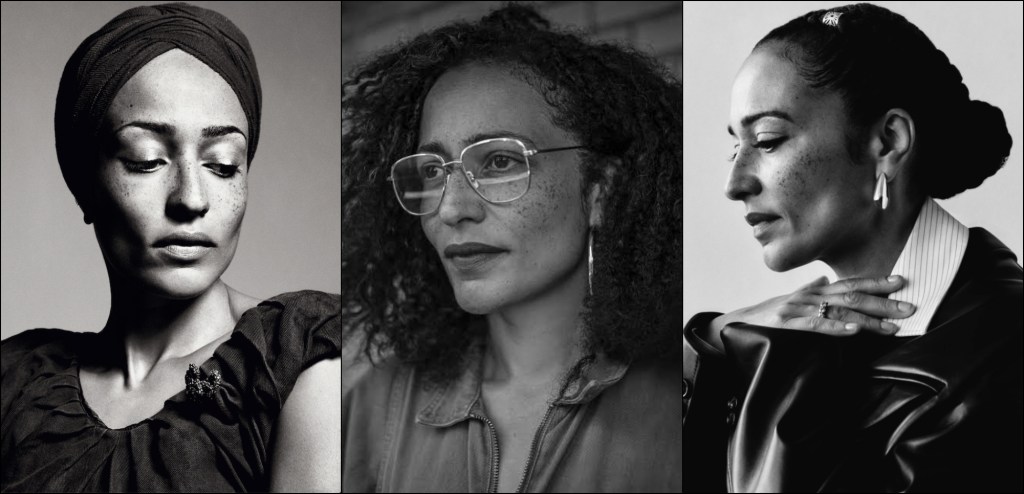
Right: Photography: Jack Davison – British Vogue
That gift becomes more formally daring in NW, where Smith seems to distrust the smoothness of the traditional novel as a vehicle for describing contemporary life. The fractured structures, shifts in perspective, abrupt changes in rhythm, lists, repetitions, compressed scenes, and linguistic collisions make the book feel less like a story being narrated than like a consciousness moving through a city. London becomes something more than setting: it becomes a pressure system, a geography of class and aspiration in which proximity does not necessarily produce intimacy. NW understands that people can occupy the same streets while inhabiting radically different realities, and that social mobility often produces its own peculiar forms of alienation because the person who leaves one world may never become entirely legible in another. Smith’s formal experimentation therefore has an ethical dimension; the brokenness of the narrative is not ornament but an attempt to make form answer to experience. The novel’s famous attention to speech, neighborhood, class markers, and social performance reveals Smith listening to people as carefully as she watches them. She is interested in the sentence as evidence.
That attention to language is one reason Smith’s nonfiction matters so much to an understanding of her career, because the essayist in her has always been observing the novelist at work. Changing My Mind, Feel Free, Intimations, and Dead and Alive reveal a mind that does not treat criticism as the place where a writer becomes certain, but as the place where uncertainty can be given shape. Her essays range across literature, film, politics, race, celebrity, technology, visual art, death, and the experience of being a person trying to remain intellectually awake in a culture increasingly organized around speed and spectacle. Dead and Alive, published in 2025, gathers essays concerned with artists including Toyin Ojih Odutola, Kara Walker, Celia Paul, Joan Didion, and others, while also returning repeatedly to mortality, memory, artistic inheritance, and the problem of what it means to look at another person’s work honestly. Smith’s criticism has always possessed a kind of doubleness: she is capable of admiration without surrender, and skepticism without cynicism. She does not seem interested in proving that an artist is good; she is interested in finding the precise location where the work becomes alive.
This is increasingly important in Smith’s later career because age has altered the position from which she writes. The young novelist who once had to answer questions about being a prodigy has become a writer interested in the dead, the remembered, the inherited, and the unfinished, and Dead and Alive makes that movement impossible to ignore. The collection’s title itself carries the argument: artistic life does not end neatly with biological death, because artists continue to enter the consciousness of those who read, study, imitate, resist, misunderstand, and inherit them. Smith has recently spoken about reading more women as she grows older, and that detail is revealing because it suggests that literary inheritance is not fixed at the moment we first discover ourselves as readers. We can become newly conscious of the writers who were always there but whom history, education, taste, or cultural authority taught us to overlook. The mature Smith therefore seems less interested in establishing herself as an authority than in interrogating authority itself: who granted it, who received it, who was excluded from it, and what happens when we begin reading the archive differently. Her literary life has become an argument for revision.
Namwali Serpell’s imagination begins somewhere else, in the unstable territory between literary scholarship and speculative invention, where the future is not an escape from history but one of its consequences. The Old Drift is extraordinary partly because it refuses the familiar pressure placed upon African literature to make itself immediately legible through realism, and instead gives Zambia an expansive fictional architecture capable of holding colonial history, family saga, technological speculation, satire, myth, science fiction, and grotesquerie simultaneously. The novel’s scale is not indulgence; it is an argument about what scale African history deserves. Serpell’s Zambia cannot be reduced to a political backdrop because the country itself becomes a participant in the novel’s imagination, carrying its histories forward into bodies, families, technologies, desires, and futures. Her use of the mosquito chorus is particularly telling because it destabilizes the assumption that the human being must always occupy the center of narrative consciousness. Serpell’s formal imagination keeps asking what literature might become if we changed the narrator, the scale, the chronology, or even the definition of what counts as a character.
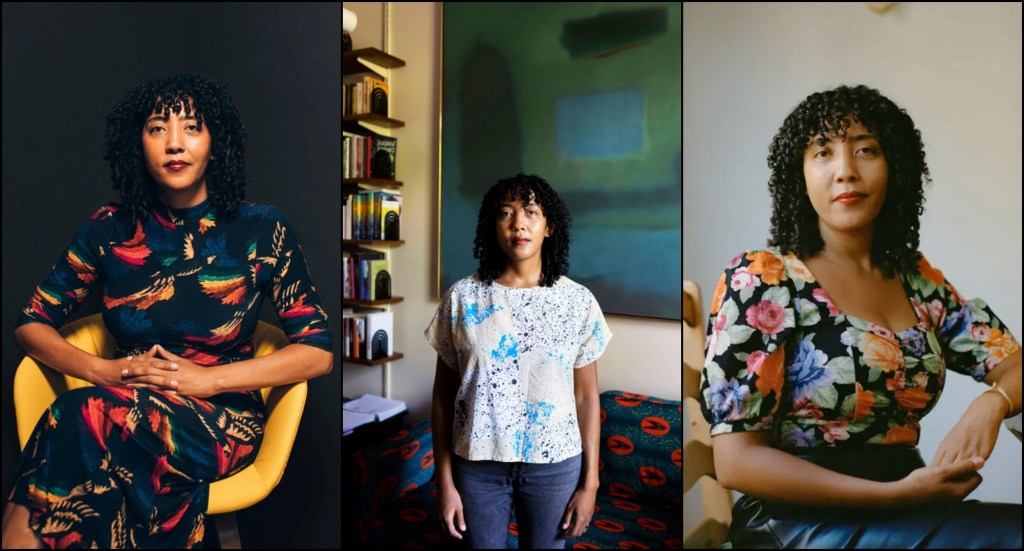
Left to Right: Jordan Kines Photography, Nate Palmer for New York Times, Jillian Freyer for The New Yorker
That impulse is connected to Serpell’s scholarly work on uncertainty, which gives a deeper philosophical context to her fiction. Her academic book Seven Modes of Uncertainty investigates the ways literature can make uncertainty productive rather than merely frustrating, and that idea becomes almost architectural in The Old Drift and The Furrows. Serpell does not use ambiguity simply to make a reader work harder; she uses it to expose the limits of the reader’s desire for mastery. We want to know what happened, who someone really is, what a memory means, whether a strange event is supernatural or psychological, whether a future is inevitable, and whether a character’s explanation of herself can be trusted. Serpell repeatedly gives us enough information to form a theory and then introduces something that destabilizes it. This is not coyness; it is a serious theory of reading, one in which the reader’s discomfort becomes part of the encounter with the work. Uncertainty becomes an ethical position because it forces us to acknowledge how quickly we turn other people’s lives into stories we believe we understand.
The Furrows brings that philosophy into the most intimate possible territory: grief. Its central wound is the disappearance and death of Wayne, the brother of its protagonist, and the novel’s peculiar repetitions and shifts make mourning feel less like a chronological process than a distortion of time itself. The dead do not remain obediently in the past; they return through resemblance, memory, possibility, fantasy, and the unbearable imagination of what might have happened differently. Serpell understands something that sentimental literature often avoids: grief is not simply sadness but a crisis in epistemology, because the mourner knows something has happened while simultaneously experiencing the mind’s refusal to make that knowledge emotionally final. The question becomes not only who has died but how a person continues to exist inside someone else’s perception after death. Serpell’s formal choices make that contradiction visible rather than resolving it into therapeutic clarity. The result is a novel in which narrative instability becomes an accurate representation of emotional instability.
Serpell’s relationship to Toni Morrison makes this commitment to difficulty even clearer, particularly in On Morrison, her 2026 collection of essays devoted to Morrison’s novels, criticism, poetry, plays, and editorial work. Serpell’s most provocative decision is also the simplest: she refuses to make Morrison into a monument. She wants the work rather than the icon, the sentence rather than the celebrity, the craft rather than the cultural shorthand. In interviews surrounding the book, Serpell has repeatedly emphasized that Morrison’s artistry can become obscured when discussions of her are dominated by her identity and public significance, and she argues instead for the seriousness of Morrison’s aesthetic achievement. That position is particularly powerful coming from a Black woman scholar and novelist because it refuses the expectation that Black women writers should be grateful merely to be represented while their formal intelligence is treated as secondary. Serpell’s criticism insists upon something more demanding: Black writers deserve to be read as artists of enormous technical complexity.
That argument also clarifies what Serpell means when she speaks about difficulty. Difficulty is often used against Black women, particularly when they refuse to make their intelligence soothing, their politics agreeable, or their artistic intentions immediately transparent. Serpell’s criticism reverses that accusation by suggesting that difficulty can be a form of respect: the writer trusts the reader enough not to simplify the work for her, and the reader accepts the responsibility of meeting the work at its level of complexity. In her discussions of Morrison, Serpell has emphasized the danger of reducing a writer to a symbolic identity and has argued for reading Morrison with the seriousness that her aesthetic innovations demand. This is not an argument against identity; it is an argument against identity becoming the only permissible method of interpretation. Morrison can be Black, female, American, historical, political, and culturally consequential while also being a technician of rhythm, syntax, narrative perspective, irony, genre, voice, and structure. Serpell understands that to insist upon all of these things at once is not to make the work harder than it needs to be; it is to give the work back its full size.
Smith operates within a related tension, although her relationship to identity is often more openly comic and socially observational. She has spent much of her career being asked to represent categories—Black British, biracial, female, immigrant-adjacent, multicultural, cosmopolitan—and her fiction has repeatedly demonstrated how inadequate those categories become once actual people begin speaking. The temptation surrounding a writer like Smith is to treat her biography as the master key to her books, but On Beauty, NW, Swing Time, and The Fraud consistently resist such reduction. Their characters are shaped by race and class, but they are also shaped by vanity, desire, jealousy, art, money, friendship, sex, education, embarrassment, ambition, and accident. Smith’s great comic instinct may be precisely her refusal to let anyone remain politically or psychologically pure for very long. She knows that people can possess admirable politics and terrible personalities, radical ideas and bourgeois desires, genuine love and extraordinary selfishness. The novel becomes the place where these contradictions are permitted to coexist without requiring a verdict.
This is where Smith and Serpell become especially interesting together: both are deeply concerned with what happens when literary art is asked to carry more ideological weight than it can reasonably bear. Smith’s essays have long resisted the flattening of art into political messaging, while Serpell’s criticism of Morrison explicitly asks readers to attend to aesthetics, technique, and form alongside historical and political meaning. Neither writer is politically disengaged; quite the opposite. They understand that form itself can be political because the decision about who narrates, whose language is considered sophisticated, which histories receive complexity, and how much difficulty a reader is expected to tolerate all involve power. But neither allows politics to become an excuse for aesthetic laziness. Their work insists that the political life of literature becomes richer when the literature itself is allowed to be strange, beautiful, excessive, contradictory, funny, difficult, and formally ambitious. That is a radical proposition in a culture increasingly inclined to explain a book before allowing anyone the time to experience it.
Their careers also illuminate another form of inheritance: the inheritance between teachers, readers, critics, and novelists. Serpell’s classroom is not incidental to her writing; her teaching of Morrison eventually became the foundation for On Morrison, demonstrating how sustained engagement with students can transform private scholarship into a public book. Smith’s essays likewise show the novelist as a reader, and perhaps this is one reason her nonfiction has remained so important to her development: she is continually demonstrating that writers are formed by the arguments they have with other writers. Neither woman appears to believe that originality means creating without ancestors. Originality, rather, emerges through intense contact with what has already been made. One reads, disagrees, imitates, steals rhythm, rejects an assumption, discovers a forgotten influence, and eventually produces something that could not have existed without the earlier work but is no longer reducible to it.
There is something particularly moving about Serpell’s relationship to Morrison because of the strange intimacy she describes between writers who never knew one another personally. In discussing On Morrison, Serpell has spoken about discovering an eerie correspondence between Morrison’s inspiration for Dreaming Emmett and a scene in Serpell’s own The Furrows, both involving a Black boy in an airport and the possibility of sudden violence. The coincidence matters because literary inheritance rarely operates in the orderly way we imagine influence operating. Sometimes an artist teaches another artist through a book; sometimes through a sentence; sometimes through a problem they could not solve; sometimes through an image that seems to arrive independently and only later reveals its ancestry. Serpell’s encounter with Morrison therefore becomes more than scholarship—it becomes a recognition of how artistic minds can meet across time without ever having occupied the same room. The archive can be intimate even when the artist is absent.
Smith’s inheritance is similarly expansive, though her method has often been to place writers, artists, and cultural objects beside one another until unexpected relationships become visible. Her essays possess the quality of a mind wandering without actually becoming lost, moving from a painting to a novel, a film to a political question, a musician to a memory, and discovering that the apparent detour was the argument. That capacity for associative thought is one of her defining gifts, but it also explains why her work has become increasingly valuable as she has aged: she has accumulated enough cultural memory to recognize connections that might not have been visible earlier. The writer becomes less interested in announcing what something means than in demonstrating how meanings accumulate. Dead and Alive is consequently not merely a collection of miscellaneous criticism but a portrait of an artist becoming increasingly conscious of time. The dead, the living, the famous, the forgotten, the young, and the aging all occupy the same intellectual room.
And perhaps that is the deepest correspondence between Smith and Serpell: neither writer believes that literature’s responsibility is to make the world simpler than it is. Smith’s comedy makes complexity bearable without denying its consequences, while Serpell’s speculative and formally experimental work makes complexity strange enough that we can no longer mistake familiarity for understanding. Smith asks what happens to people when history, class, race, desire, and ambition collide in the ordinary spaces of contemporary life; Serpell asks what happens when history refuses to remain chronological and when memory, technology, grief, and futurity begin speaking over one another. One is often urban and social in her gaze, the other expansive and speculative, but both are intensely interested in the same human problem: how do we know what we think we know about another person? Their answers are never final. Their books remain open because the people inside them remain larger than the explanations available to them.
The significance of their careers, then, is not simply that Smith and Serpell are accomplished Black women who have entered and transformed literary institutions, although that fact should never be minimized. It is that they have used those institutions without allowing the institutions to dictate the limits of their imaginations. Smith became famous through a novel that was widely treated as a generational statement and then spent the following decades refusing to become the writer of one generation, one subject, one city, or one style. Serpell emerged as a scholar of uncertainty and then made uncertainty the material of fiction, before turning her critical intelligence toward Morrison with a book that argues, in effect, that greatness should not exempt a writer from close reading. Both careers therefore demonstrate a kind of intellectual independence that is rarer than literary fame. They are not merely producing books; they are continually revising the conditions under which their books can be read.
The gift these writers offer may ultimately be the gift of permission: permission to make difficult things, to change forms, to read against the expected interpretation, to be intellectually ambitious without apologizing for ambition, and to understand that a Black woman writer does not have to choose between being culturally meaningful and being aesthetically strange. Smith and Serpell both know that the demand for accessibility can sometimes conceal another demand—the demand that certain writers make themselves smaller before the audience will agree to listen. Their response is not obscurity for obscurity’s sake but complexity as an assertion of full humanity. A complicated sentence can be a complicated life rendered honestly; a fractured narrative can be a fractured memory; an unfamiliar structure can be the most truthful structure available. What looks difficult from a distance can become intimate once we surrender the desire to master it.
The lasting pleasure of reading them is that neither writer seems finished with the question of what writing can do. Smith continues to look backward while moving forward, reconsidering artists, forms, cultural assumptions, and the meanings of a life lived alongside literature; Serpell continues to move between the archive and the speculative future, between the classroom and the novel, between Morrison’s sentences and the possibilities those sentences opened for another generation of writers. Their careers remind us that literary maturity is not the narrowing of one’s concerns but the refinement of one’s attention. The older a writer becomes, the more she may understand that everything connects, but connection is not the same as simplification. Smith and Serpell have made careers from that distinction, asking us to look again at the familiar, to distrust the easy reading, and to understand that the most generous form of literary criticism may be the refusal to make a work smaller than it is. In their hands, writing becomes not an answer to the world but a disciplined way of remaining awake inside it.

