By Jordannah Elizabeth Graham-Mayer
The freshness, and stable vulnerability of John Mayer before the machinery of John Mayer had fully assembled itself is not only enlightening when it comes to his foundational absorption of music, film, art, love and time; it reveals a maturity within his youth. His long-winds are there, like they have always have and will likely always be, but they are doused in the discovery in memory and nostalgia more his charming declarative understanding of the development of his manhood.
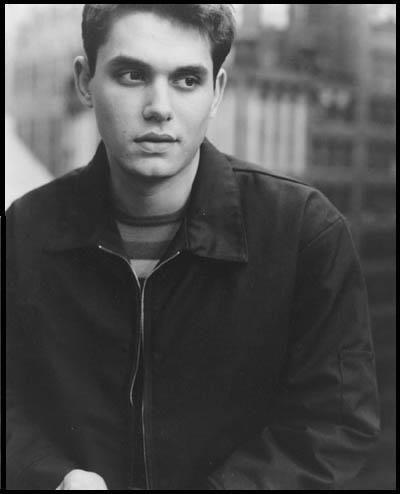
Before the magazines, the television appearances, the Grammys, and the mythology of the guitar, there was a young musician in Atlanta making songs that sounded as though they had been left open on a desk overnight. Inside Wants Out, released independently in September 1999, is not merely an early recording; it is evidence of a person still negotiating the distance between private musical instinct and public performance. Four of its songs would later be reworked for Room for Squares, but the distinction between those records is more emotional than simply sonic. The later album knows what a listener is supposed to hear, while Inside Wants Out often sounds as though it is discovering the listener as it plays. That difference becomes even more revealing when placed beside Any Given Thursday, recorded at Birmingham, Alabama’s Oak Mountain Amphitheatre on September 12, 2002, and released on February 11, 2003.
The young Mayer had already lived several musical lives before the public met him as the affable songwriter of “No Such Thing.” After graduating from high school in 1995, he worked at a gas station and played blues clubs before enrolling at Berklee College of Music in Boston, where he remained for two semesters. He then moved to Atlanta with Clay Cook, and the city became the setting for a more informal education: clubs, open mics, records, other musicians, and the peculiar education of trying to make a living before anyone had decided you were worth listening to. Mayer had become fascinated with Stevie Ray Vaughan as a teenager after hearing a cassette of Vaughan’s music, at a moment when many of his peers were absorbed in alternative rock. That contradiction—an emerging songwriter with a pop sensibility carrying the vocabulary of electric blues—would remain one of the most important tensions in his career. It is also one reason Inside Wants Out deserves to be heard as something more complicated than a rough draft of Room for Squares.
Inside Wants Out has the intimacy of a musician who has not yet learned to disguise the room in which the song was made. The recordings are predominantly acoustic, with Mayer’s voice and guitar occupying the center without the protective architecture that a major-label production can provide. Even the weaknesses are informative: the closeness of the recording makes breaths, hesitations, changes in vocal pressure, and the physical mechanics of guitar playing part of the composition. “No Such Thing,” “Back to You,” “My Stupid Mouth,” and “Neon” would eventually receive more polished treatments on Room for Squares, but their earlier forms reveal how much of Mayer’s appeal was already present before the industry had decided how to package it. There is a young man trying to sound casual while taking songwriting very seriously, which is a recognizable emotional state for anyone who has ever been twenty-something and terrified of becoming ordinary. The songs are concerned with adulthood, romantic uncertainty, self-consciousness, and the strange feeling of watching your own life become a story before you understand its plot.
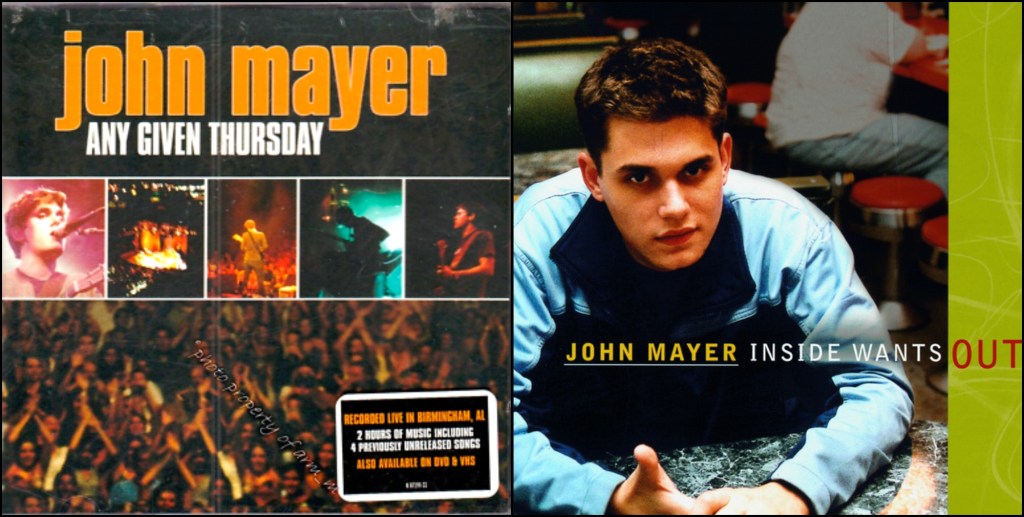
The title itself feels almost like a miniature manifesto. Inside Wants Out describes the impulse behind a great deal of singer-songwriter music: the private thing becomes unbearable if it remains private. Mayer was not simply writing songs; he was developing a mechanism for externalizing interior experience, and the songs often turn ordinary details into emotional evidence. “Victoria” observes the collapse of a relationship through small movements rather than grand declarations, while “Comfortable” has the particular ache of remembering an intimacy that no longer exists in the same form. “Love Soon” is younger and less settled, almost embarrassed by its own hopefulness, whereas “Quiet” seems to understand that sometimes emotional intensity arrives through restraint. These are not necessarily the most sophisticated songs Mayer would ever write, but they possess the quality that makes early work valuable: they show an artist discovering which parts of himself are transferable into sound.
There is also something important about where these songs came from. Mayer’s early career coincided with a brief, strange period in which the internet could function as an alternative musical infrastructure rather than simply another branch of the entertainment industry. He built a local following through the Atlanta club circuit, particularly at Eddie’s Attic, while his early recordings circulated independently before his eventual relationship with Aware Records and Columbia. That culture of circulation mattered because it allowed the music to travel before a conventional marketing apparatus had completely defined its meaning. An unknown singer-songwriter could move from a coffeehouse to a website to a burned CD to a college campus without necessarily passing through the gatekeeping rituals of radio first. In retrospect, Mayer’s rise can look inevitable, but the archive shows something much messier: a musician gradually becoming legible to an audience that was already looking for him.
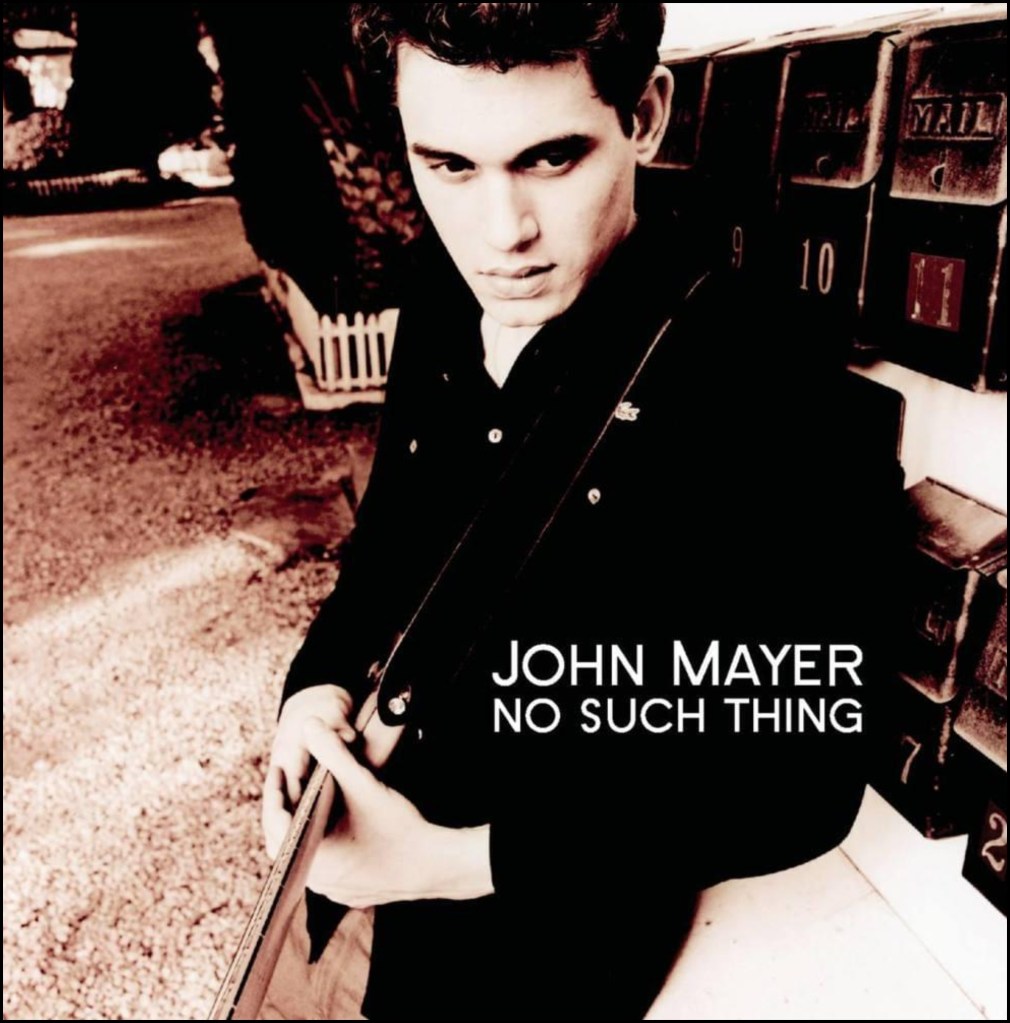
By the time Room for Squares arrived in 2001, the private song had become a public proposition. Aware Records initially released the album online in 2001, and Columbia subsequently remixed and re-released it in September of that year. The first four songs were reworked versions of material that had appeared on Inside Wants Out, effectively allowing the industry to take Mayer’s small-room songs and give them a larger room to inhabit. “No Such Thing” is perhaps the clearest example: the song’s rejection of the prescribed “real world” became a pop-radio anthem for young people who were themselves being asked to decide what adulthood would look like. Its music video, directed by Sam Erickson, was filmed at the Georgia Theatre in Athens after Mayer was denied permission to shoot at his former high school because administrators objected to the song’s criticism of school and its faculty. The irony is beautiful in retrospect: a song about resisting institutional expectations became one of the mechanisms by which Mayer entered the institution of mainstream pop.
The videos from this period are worth revisiting because they capture a transitional image of Mayer that the albums alone cannot. “No Such Thing” presents him as a performer in a room, not yet as a fully manufactured celebrity, while “Your Body Is a Wonderland,” released as a single in June 2002, moved him toward a more sensual and polished visual language. The latter video, directed by Jim Gable and starring Holly Lynch, helped establish the image of Mayer as the soft-spoken romantic whose guitar playing complicated his otherwise approachable singer-songwriter persona. The song eventually reached No. 18 on the Billboard Hot 100 and earned Mayer the 2003 Grammy Award for Best Male Pop Vocal Performance. Yet the song’s cultural afterlife can obscure how carefully constructed its original performance actually was: beneath the softness is a musician learning how to make physical intimacy sound conversational. The tension between vulnerability and presentation would become one of the defining characteristics of Mayer’s early public identity.
Then there is Any Given Thursday, which complicates the entire picture because it demonstrates that the quiet intimacy of Inside Wants Out was never the whole story. Recorded only a few years after the EP, the Birmingham concert captures Mayer with David LaBruyere on bass, Stephen Chopek on drums, and Michael Chaves on guitars, keyboards, and backing vocals. Suddenly the songs have bodies around them, and Mayer’s guitar is no longer merely accompanying his voice but competing with the expectations created by his radio success. The album includes the hits, but it also makes room for “Man on the Side,” “Covered in Rain,” “Comfortable,” “Neon,” Stevie Ray Vaughan’s “Lenny,” and a version of the Police’s “Message in a Bottle.” It is the document of an artist discovering that the songs people came to hear can become something else once the audience is present.
The most revealing performance may be “Covered in Rain,” because it exposes the distance between Mayer the songwriter and Mayer the guitarist. In the live performance, the song becomes expansive, allowing the guitar to occupy a different emotional territory from the lyric. Rather than functioning like a conventional pop sequel, it becomes a place for the guitar to wander, linger, and eventually dominate the emotional narrative. The young singer-songwriter who had been marketed through accessible melodies suddenly seems interested in duration, tone, and improvisation. This is where the influence of Stevie Ray Vaughan becomes less biographical trivia and more audible history: the guitar is not decoration but a language capable of carrying feelings that the lyric has already exhausted. Any Given Thursday therefore becomes an early record of Mayer realizing that his most commercially useful instrument might also be his most personally revealing one.
The same thing happens in “Neon.” On Inside Wants Out, the song is almost shockingly spare: voice and guitar, with the rhythmic complexity of the guitar part doing much of the emotional labor. Onstage in Birmingham, it becomes a ten-minute event, complete with an extended instrumental passage and a band responding to the architecture Mayer had established alone. The difference is not simply that the song has become longer; it has become social. The private architecture of the original recording is opened up to other musicians, and Mayer has to respond to them in real time. This is one of the places where the early Mayer archive becomes more interesting than the mythology of the sensitive songwriter: he was not only a confessional writer but a young musician increasingly fascinated by what could happen when a song stopped behaving like a fixed object.
That distinction matters because the early public narrative around Mayer was unusually invested in his personality. Contemporary coverage presented him as an unlikely celebrity, emphasizing his shyness, outsider status, and improbable trajectory from working at a gas station to becoming a charting musician. The story leaned heavily into the fantasy of the nice, quiet young man succeeding without seeming to want celebrity, an image that was useful precisely because it contrasted with the spectacle of pop stardom around him. But the concert recordings tell a more complicated story. Mayer may have appeared hesitant in interviews, yet onstage he was increasingly assertive, extending songs, changing arrangements, and making his technical ability impossible to ignore. The discrepancy between the quiet interview subject and the expansive live musician is one of the most compelling tensions in the early archive.
The audience itself is part of this transformation. Contemporary reviews of Mayer’s 2002 performances repeatedly described crowds singing along and treating the songs as personal property, even as critics debated whether the attention was arriving too quickly. At the September 12, 2002 Oak Mountain performance, the set moved from “3×5” and “No Such Thing” through “Lenny,” “Man on the Side,” “Message in a Bottle,” “Covered in Rain,” “Comfortable,” and “Neon,” with the concert ultimately becoming a document of both the songwriter and the guitarist. What the reviews sometimes missed was the peculiar exchange taking place between performer and audience: Mayer was writing songs about uncertainty, but the audience was turning those songs into certainty through collective recognition. A song about not knowing where your life is going can become an anthem precisely because thousands of people admit, together, that they do not know either. The live recording preserves that exchange in a way a studio album cannot.
That is perhaps the most interesting thing about revisiting these records now. Inside Wants Out is not valuable because it predicts everything Mayer would become; it is valuable because it preserves the uncertainty before the prediction became possible. Any Given Thursday is equally important because it catches the opposite movement: the private songwriter beginning to understand the scale of his own musical appetite. Between them is a young artist moving from room to room, from acoustic guitar to full band, from Atlanta clubs to a major-label audience, and from intimate songs to an amphitheater filled with people singing the words back. The songs remain remarkably interested in the smallness of human experience even as the circumstances surrounding them become enormous. There is a strange poignancy in hearing a musician sing about being lost at the precise moment when his career was becoming increasingly difficult to lose.
And perhaps this is why the early work still resists easy dismissal as the music of an earlier, more naïve John Mayer. The naïveté is there, certainly, but so are discipline, curiosity, and an unusually serious relationship to the guitar. Mayer understood early that a song could be both conversational and technically demanding, that a pop melody could contain a blues vocabulary, and that a guitar could move between accompaniment and confession. Inside Wants Out shows the inward impulse before the world was listening, while Any Given Thursday shows what happens when that impulse is amplified by musicians, technology, and thousands of people singing the words back. Neither record gives us the complete Mayer, and that is precisely their strength. Together they preserve something that celebrity usually erases: the unstable interval in which an artist is still becoming, when the music knows what the person has not yet learned to say.
 Publik / Private