Written by Jordannah Elizabeth Graham-Mayer
Branford Marsalis and Dianne Reeves return to the intimate world of John Coltrane and Johnny Hartman, finding new freedom in songs that have already lived several lifetimes.
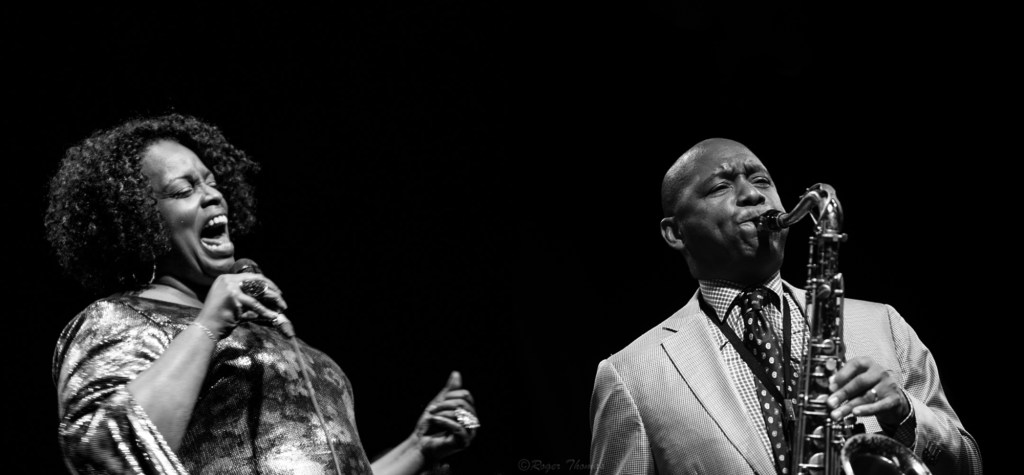
Some albums arrive carrying history; some albums are mysterious, others austere and emotive. Yet, there are times when an anniversary of an era emerges, like a centennial that brings a long time coming-esque project into fruition.
Dedicated to You, the forthcoming collaboration between Branford Marsalis, Dianne Reeves, and the Branford Marsalis Quartet was created in celebration of John Coltrane’s centennial, the album revisits the six standards associated with Coltrane’s landmark 1963 collaboration with Johnny Hartman while expanding the conversation through instrumental performances drawn from Coltrane’s canon. Rather than attempting to reproduce the sound of that celebrated Impulse! recording, Marsalis and Reeves approach its repertoire as living music—material that can still breathe, shift, and reveal something unexpected. Released by Blue Note Records on September 18, 2026, Dedicated to You arrives not simply as a tribute to Coltrane, but as a meditation on what happens when musicians return to songs whose emotional lives have already been shaped by generations of listeners.
The decision to begin with John Coltrane and Johnny Hartman is central to understanding Dedicated to You. When Marsalis was approached about participating in the centennial celebrations, he immediately liked the idea but wanted to take what he called “a road less travelled.” Instead of reaching for the recordings most commonly associated with Coltrane’s radicalism, he was drawn toward an album built almost entirely on standards—songs whose melodies and lyrics were already deeply familiar to American listeners. That choice is more daring than it initially appears. A standard leaves nowhere to hide: the melody is known, the lyric is known, and the emotional architecture has been carried by other singers and musicians before you. The question becomes not whether you can make the song different, but whether you can make someone hear what was already there.
The ballad is perhaps the most unforgiving form of that challenge. At a slower tempo, there is nowhere for a musician to outrun an uncertain phrase or disguise an emotional choice beneath velocity. Every breath becomes audible; every pause acquires weight. On Dedicated to You, that spaciousness allows Reeves and Marsalis to explore the qualities that made the Coltrane/Hartman recording so enduring: intimacy, patience, tonal beauty, and an almost conversational relationship between voice and saxophone. The songs are not treated as empty vessels waiting for virtuosity to fill them. They arrive already complete, and the musicians’ task is to discover where they can enter without disturbing the song’s essential character. In that sense, restraint becomes not an absence of invention but one of its most sophisticated forms.
The six vocal standards at the heart of Dedicated to You—“Autumn Serenade,” “Dedicated to You,” “You Are Too Beautiful,” “Lush Life,” “My One and Only Love,” and “They Say It’s Wonderful”—also reveal how expansive the idea of a “standard” can be. These songs do not all occupy the same emotional world. “Autumn Serenade” carries the delicacy of seasonal memory, while “Lush Life” moves toward something darker and more psychologically complicated, its lyric tracing the aftermath of romantic disillusionment. “My One and Only Love” is almost unbearably direct in its declaration of devotion, while “You Are Too Beautiful” depends on a more fragile balance between admiration and vulnerability. Taken together, the songs create an emotional arc that is more complicated than the word “standards” suggests. They are songs about desire, memory, loneliness, devotion, regret, and the difficulty of saying what we mean when the stakes are intimate.
“Lush Life,” in particular, demonstrates why these songs continue to invite reinterpretation. Billy Strayhorn’s composition is often described as a standard, but its emotional terrain is anything but standardized. Its sophisticated harmonic language and long, conversational lyric require a singer to negotiate between elegance and exhaustion, between the surface beauty of the arrangement and the darker experience underneath it. Reeves has spent a career developing precisely that kind of interpretive intelligence—the ability to allow a lyric to remain sophisticated without making it emotionally distant. In a project centered on Coltrane, it is significant that the most radical gestures may come from simply allowing a lyric its full weight. The song does not need to be reinvented to become contemporary; it needs to be heard honestly.
The same is true of “My One and Only Love,” a song whose emotional directness could easily become sentimental in less careful hands. Its power depends on vulnerability, but vulnerability in jazz is rarely achieved by simply increasing the emotional volume. It comes through phrasing, breath, timing, and the willingness to leave a little space around a declaration. This is where Reeves’ philosophy, shaped in part by her teenage work with Clark Terry, becomes especially relevant. Terry taught her to understand what a song needs—sometimes embellishment, sometimes space, sometimes nothing at all. That lesson is particularly valuable with ballads because the temptation to overstate them is always present. Reeves instead approaches the material as a storyteller, allowing the emotional meaning to emerge gradually rather than insisting upon it.
Dedicated to You, the song that gives the album its title, carries its own significance within this collection. The title can be heard as a direct gesture toward Coltrane, but the song itself complicates that dedication by making the language personal. A dedication is an act of giving something to another person, and that idea resonates throughout an album built on musical inheritance. Hartman once gave these songs his voice; Coltrane gave them another dimension through his playing; Reeves and Marsalis now receive that inheritance and return it in another form. The title therefore works on several levels at once—an album title, a song, and a statement about the nature of artistic memory. Music passes from one person to another, and each act of passing changes it slightly.
Marsalis understands the danger of treating these songs too carefully. The original Coltrane and Hartman sessions had a recognizable arrangement philosophy, but he did not want to simply reproduce the architecture of the 1963 record. His quartet—pianist Joey Calderazzo, bassist Eric Revis, and drummer Justin Faulkner—worked with Reeves as an integrated ensemble, playing each piece together before deciding what needed to be added or removed. That process is especially important with ballads because the arrangement is part of the emotional meaning. A piano introduction can establish a memory before the singer enters; a bass note can make a lyric feel suddenly more vulnerable; a drummer can choose whether a phrase moves forward or simply hangs in the air. The arrangement does not decorate the song—it teaches us how to listen to it.
Reeves’ description of great singers standing “in the band, not in front of the band” gets to the heart of this approach. On a great ballad, the singer is not simply delivering words while the musicians provide atmosphere. Everyone is participating in the emotional construction of the song. Marsalis can answer a lyric with a saxophone phrase, or deliberately refuse to answer it; Calderazzo can leave a chord unresolved; Revis can deepen the harmonic pull beneath a single word; Faulkner can make silence feel rhythmic. The voice becomes one color within a larger palette rather than the unquestioned center of attention. That is the kind of ensemble relationship that made John Coltrane and Johnny Hartman extraordinary, and it is one of the qualities Dedicated to You seeks to carry forward.
The first single, “They Say It’s Wonderful,” is therefore an ideal introduction to the album. The song is almost deceptively simple in its premise, but its emotional power comes from the distance between what people say love will be and what love actually feels like. Reeves does not need to overplay that tension. Her phrasing can allow the lyric to carry its own ambiguity, while Marsalis and the quartet create enough space for the words to resonate. Because Hartman’s interpretation is so deeply embedded in the history of the song, any new version inevitably enters into conversation with his. Reeves does not attempt to replace that memory; she adds another layer to it. The song becomes less a contest between interpretations than evidence of how a standard can continue accumulating meaning.
“Central Park West,” the album’s second released preview, shifts the conversation from voice to instrument. Marsalis performs Coltrane’s composition on soprano saxophone with Calderazzo on piano, creating a much smaller musical space in which melody and phrasing become the primary events. The piece is a reminder that Dedicated to You is not solely a return to John Coltrane and Johnny Hartman, but a broader engagement with Coltrane as composer and improviser. Its presence alongside the vocal standards creates a useful tension: the album can move from the intimate storytelling of a singer to the instrumental language through which Coltrane expressed his own inner world. The two approaches are different, but they are connected by the same principle of attentive listening. “Central Park West” makes the case that intimacy was never separate from Coltrane’s experimentation; it was one of the ways he expressed it.
The confirmed track list deepens that connection. Alongside the six vocal standards, Dedicated to You includes instrumental readings of Coltrane compositions such as “Big Nick,” “26-2,” and “Central Park West,” while the digital edition adds “Say It (Over and Over Again),” “Nancy (With the Laughing Face),” and “Big Nick (Trio).” The program consequently moves between songs that entered jazz through the American songbook and compositions that belong more directly to Coltrane’s own musical imagination. That distinction allows the album to explore not only how Coltrane interpreted standards, but how other musicians can now interpret the music he left behind. It also prevents the project from becoming a museum-like reconstruction of one historic collaboration. Instead, Dedicated to You creates a larger portrait of the relationship between composition, interpretation, and improvisation.
Marsalis’ conception of Coltrane is important here because it rejects the idea that innovation requires rejecting everything that came before. He describes Coltrane as someone who understood swing, early R&B, and post-bop and absorbed those traditions before extending them. The image of Coltrane as an artist continually breaking away from convention is incomplete without the equally important image of Coltrane as a student of musical history. His originality depended upon listening deeply enough to recognize what was already possible. That is the lesson Marsalis brings to Dedicated to You: the musicians do not have to destroy the songs in order to discover something new inside them. They have to know the songs well enough to recognize where the newness might already be waiting.
Newness is often assumed to require unfamiliar material, new production, or a rejection of established forms. But Dedicated to You suggests another possibility: that familiarity itself can become a form of depth. The more times a song has been heard, the more difficult it can be to surprise us—and therefore the more meaningful a subtle change can become. A breath held slightly longer, a melody left untouched, a chord voiced differently, a phrase allowed to fall into silence: these can be radical choices when the listener already knows what comes next. The album’s innovation is therefore measured not by how far it moves from the original recordings, but by how much more closely it asks us to listen.
That balance may be the defining quality of Dedicated to You. It is a centennial album, but it does not feel trapped by the calendar. Its source material reaches back to 1963, while its performances belong entirely to the musicians making them now. Reeves brings the memory of hearing Hartman at home; Marsalis brings decades of engagement with Coltrane’s musical language; Calderazzo, Revis, and Faulkner bring their own histories and instincts to the arrangements. What emerges is not a recreation of the past but a conversation between musicians who understand that inheritance is an active process. The album listens backward without becoming nostalgic.
That conversation will continue onstage. Marsalis and Reeves are scheduled to take the Coltrane project on tour beginning in September 2026, with published performances continuing into 2027 across the United States, Canada, and Europe. The live setting should give these songs yet another opportunity to change, particularly because the recording itself was built around collective discovery rather than fixed arrangements. Reeves has already suggested that she is curious about where the music might lead, telling Marsalis, “I told Branford we may even need to dance.” There is something wonderfully appropriate about that image. These are songs that have carried generations of memory, but they are not finished carrying it.
Perhaps that is ultimately what Dedicated to You understands about the standard and the ballad. They endure not because they remain untouched, but because they remain available. A great song can survive being sung differently because its emotional core is strong enough to withstand interpretation. It can hold the voice of Johnny Hartman, the saxophone of John Coltrane, the memory of a young Dianne Reeves listening at home, and the musicianship of a new ensemble without belonging exclusively to any of them. Marsalis and Reeves enter that history not to close it, but to extend it. Dedicated to You becomes an act of musical generosity: a willingness to receive what came before, listen for what remains, and give the songs another life.

