Written By Jordannah Elizabeth Graham-Mayer
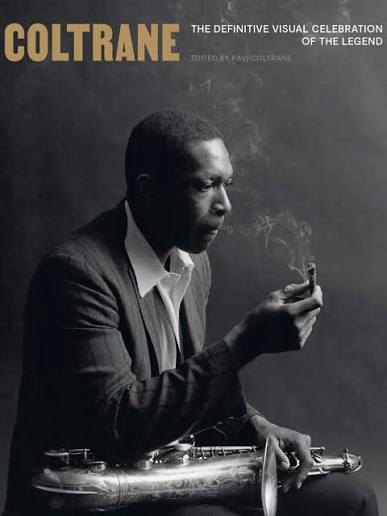
On the book, Coltrane: The Definitive Visual Celebration of the Legend, edited by Ravi Coltrane
An Introduction by John Mayer
What Remains
I have spent a good part of my life thinking about what it means for a musician to leave something behind. Not just records, not just songs, not just the recognizable evidence of a career, but something that remains in other musicians long after the original sound has stopped. You hear it in the way someone phrases a note, in the way they leave space, in the moment they decide not to play what you expected them to play. You can trace influence through technique, but that is usually the least interesting part of it. The deeper inheritance is harder to name. It is the feeling that someone who lived before you somehow gave you permission to become more fully yourself.
Coltrane: The Definitive Visual Celebration of the Legend seems, at first, like a statement about someone whose story has already been decided. But Coltrane’s story does not feel decided to me. It feels interrupted. He died in 1967 at forty years old, and there is something almost impossible about placing that fact beside the enormous amount of music he had already made. There should have been another decade, then another, and another after that. There should have been the older Coltrane, the man looking back on the young man who made Blue Train, the musician explaining what he had been hearing when he made Ascension, the elder statesman answering questions about everything that had happened since A Love Supreme. We never got that version of him. Instead, we have the work, the people who knew him, the people who loved him, and now this book, assembled by his son.
Ravi Coltrane’s role changes everything.
There is a difference between being asked to remember a great musician and being asked to remember your father. Ravi was born into a story that the rest of the world already considered complete. John Coltrane was already becoming John Coltrane in the historical imagination by the time Ravi was old enough to know what his father’s name meant. The public had its version of him: the serious face, the saxophone, the genius, the spiritual seeker, the innovator. Ravi inherited something much more complicated. He inherited the private person underneath all those descriptions, as well as the responsibility of watching that private person become one of the most consequential musicians of the twentieth century. -JM
The Photograph and the Sound
John Coltrane has been photographed so many times that certain images have become almost indistinguishable from the music itself. We know the lowered head, the saxophone held close to the body, the concentrated face, the posture of a person apparently listening to something beyond the room. These images have helped create the Coltrane we carry in our minds, but they have also made it easy to forget that the person inside those photographs was not born a legend. He was a working musician who practiced, traveled, collaborated, loved, struggled, raised a family, entered studios, waited for cues, and spent his life trying to understand what sound could become. Coltrane: The Definitive Visual Celebration of the Legend is valuable precisely because it brings some of that physical reality back into view. Edited by Ravi Coltrane, the volume gathers more than two hundred photographs and contributions from musicians, artists, writers, and cultural figures who encountered Coltrane’s music as something more than an important chapter in jazz history.
The book arrives at an unusual point in time because 2026 marks the centennial of Coltrane’s birth. The official Coltrane Estate has organized a year-long Coltrane 100 celebration that includes archival releases, performances, recordings, and projects designed to reconsider the breadth of his influence. The photographic book belongs naturally inside that larger reconsideration because it does not attempt to settle Coltrane’s meaning so much as reopen the archive around him. It places the famous photographs beside images that allow us to imagine the circumstances in which the music actually happened. There are candid photographs from the recording of Blue Train, outtakes from the Ascension album-cover session, and a remarkable backstage glimpse of John and Alice Coltrane before their first performance together. These are not simply additional illustrations for a familiar story; they are pieces of evidence that make the familiar story feel less finished.
That distinction matters because the word “legend” can sometimes push an artist too far away from us. A legend is easier to admire than a person, because a legend has already been resolved by history. Coltrane was never resolved in his own lifetime, and his music becomes less interesting when we pretend that it was. His career was a continuous movement away from whatever he had just learned, and the photographs give us a way to see that movement rather than simply celebrating its destination. The young musician in a studio, the husband beside Alice, the father with his family, and the performer absorbed in the instrument all belong to the same life. The visual record reminds us that the extraordinary came out of the ordinary conditions of human existence.
The Son Looking at the Father
Ravi Coltrane’s presence changes the emotional temperature of the book. He is not approaching this archive only as a musician, historian, or curator, but as the son of a man who died when Ravi was still an infant. He has subsequently spent his life as a saxophonist, composer, bandleader, and custodian of the Coltrane family legacy, including efforts to preserve the John Coltrane Home and to oversee important reissues of his parents’ recordings. That makes the act of looking at these photographs fundamentally different from the way an outside biographer might look at them. A historian sees evidence, while a son can also see absence, resemblance, family, and the strange fact that a private face eventually became public property. Ravi Coltrane is therefore working within a space where cultural history and personal inheritance cannot be separated.
This is particularly moving when the photographs allow John Coltrane to appear relaxed. The serious Coltrane is everywhere in the cultural imagination, but photographs of him smiling, laughing, or simply existing away from the stage have a different force. JazzTimes notes that the book’s intimate images allow us to see aspects of Coltrane that are less familiar, including photographs connected to Alice and their children. The effect is not to make Coltrane less profound, but to give his profundity a human scale. It becomes possible to imagine the person between the performances rather than only the performer during them. Sometimes a smile can tell us more about a life than another photograph of a genius looking intensely into the middle distance.
There is something quietly radical about allowing a great artist to remain ordinary for a moment. We are accustomed to biographies that build toward achievement, as though every childhood experience, every relationship, and every hardship existed only to produce the masterpiece that came later. Coltrane’s life was certainly shaped by extraordinary musical ambition, but the photographs resist the idea that his humanity was merely preparation for his greatness. They show a man among other people, and that matters because music is never created in isolation even when we remember it that way. Behind every canonical recording are rooms, conversations, friendships, marriages, arguments, teachers, collaborators, instruments, bodies, and time. The archive gives some of those things back to us.
Alice and John
The photographs of John and Alice Coltrane may be among the most meaningful images in the entire volume because their relationship represents a meeting of two artistic and spiritual lives that would continue to reverberate after John’s death. Alice was not merely the woman beside an important musician; she was herself a major composer, pianist, harpist, spiritual seeker, and bandleader whose later work expanded the possibilities of jazz in another direction. Her recollections of John describe a relationship grounded in music, conversation, spirituality, and intimacy, including a memory of him following her backstage with his horn and playing to her as a form of tenderness.
The new book’s photograph of the couple backstage before their first performance together therefore carries more than historical value. It shows us the beginning of a musical and personal dialogue whose consequences extended well beyond John’s lifetime.
John Coltrane’s spirituality is often discussed as though it were a separate category from his music, but the two became increasingly inseparable. After his recovery from addiction in 1957, he experienced what he understood as a profound spiritual awakening, and his subsequent work increasingly treated music as a form of devotion and inquiry. A Love Supreme is perhaps the clearest expression of that impulse, but the spiritual trajectory continues through Meditations, Om, Ascension, and the increasingly expansive recordings of his final years. Alice later described his purpose in deeply religious terms, saying that he had dedicated his life and musical endeavors to God. For Coltrane, then, the instrument was not simply a means of expression; it was one of the places where a life could be examined.
This is one reason photographs of Coltrane can feel almost devotional even when they depict nothing explicitly religious. The face becomes an instrument of concentration, and concentration becomes a kind of spiritual posture. Yet there is a danger in turning that posture into sainthood because sainthood can erase struggle. Coltrane’s spiritual life was not a clean ascent from darkness into enlightenment; it was a continuous practice of trying to become more attentive, more disciplined, and more truthful. His music retains the sound of that effort. The photographs do too, particularly when they show the musician working rather than simply posing.
The Discipline Inside the Freedom
Coltrane is frequently described as a musician of freedom, but freedom is an incomplete description of what he achieved. His most radical music was built upon an extraordinary accumulation of discipline, study, memory, and technique. John Szwed’s writing on A Love Supreme and Coltrane’s later work emphasizes that the apparent freedom of his music emerged from years of patient study and practice rather than from an abandonment of structure. Amiri Baraka made a related point in his appreciation of Coltrane, describing him as both rooted in tradition and relentlessly searching for new means of expression. The contradiction is essential: Coltrane’s freedom was not the absence of form but the ability to move through form without allowing it to become a prison.
That idea becomes especially vivid when we think about Giant Steps. The record is often treated as a technical monument, and understandably so, because its harmonic architecture remains a challenge to musicians decades later. But listening to it only as a display of technical brilliance misses something more important. The music sounds like a mind moving faster than the structure can contain it. The chords become a landscape that Coltrane does not simply navigate but interrogates. What matters is not that he conquered the changes, but that he used mastery as a reason to ask what might exist beyond them.
The same principle eventually leads toward Ascension. By 1965 and 1966, Coltrane was expanding the quartet into larger, more volatile forms, bringing together musicians whose individual voices could create something closer to a collective weather system than a conventional jazz ensemble. Ascension can sound overwhelming because it is supposed to challenge the listener’s expectation that improvisation must always be organized around the individual soloist. Szwed points out that Coltrane’s late music was not simply an escape from earlier forms but an extension of his long engagement with modes, drones, repetition, and collective sound. The outtakes from Chuck Stewart’s Ascension photographs are therefore especially evocative because they belong to the visual record of a musician in the middle of a transformation.
The People Who Heard the Future
One of the pleasures of the new book is the range of people invited to speak about Coltrane. The contributors include Ravi Coltrane, Kareem Abdul-Jabbar, Wayne Coyne, Dev Hynes, Phil Lesh, Julie Mehretu, Carlos Santana, and Patti Smith, creating a chorus that extends well beyond the conventional boundaries of jazz criticism. Their presence makes a larger argument about Coltrane’s cultural afterlife. His influence was never confined to saxophonists or jazz composers because the underlying impulse of his work could be recognized by people working in rock, poetry, visual art, popular music, and other forms of cultural expression. The book understands influence not as a chain of imitation but as something closer to inheritance.
Carlos Santana’s relationship with Coltrane is particularly instructive because Santana heard in jazz a path beyond the limitations of blues-rock virtuosity. His admiration for Coltrane eventually became explicit in Love Devotion Surrender, the 1973 collaboration with John McLaughlin that included an extended interpretation of “A Love Supreme.” Santana has continued to describe Coltrane as a central figure in his musical and spiritual development, and his later work repeatedly returns to the idea of music as a search for something larger than technique. Coltrane offered him an example of an instrumentalist whose sound could become a vehicle for transcendence. That inheritance is audible whenever Santana’s guitar seems less interested in demonstrating control than in sustaining a feeling.
Patti Smith approaches Coltrane from another direction. Her relationship to him belongs to the intersection of poetry, rock, visual art, spirituality, and the ecstatic possibilities of performance. She has written about hearing Coltrane live when she was young, and her contribution to the new book places his music within a lifelong experience of listening rather than treating him as a historical object. In the newly published excerpt from the book, Smith describes Coltrane’s music in terms of religious experience and its capacity to accompany different stages of a life. That is perhaps one of the most accurate ways to understand the endurance of Coltrane: people do not simply admire him at one age and then move on. They return to him and discover that the same recording can mean something different because they have become different.
Amiri Baraka’s appreciation carries a different historical weight because he understood Coltrane not only as a musician but as a figure within Black cultural and political consciousness. Baraka wrote that Coltrane’s music expressed the search and struggle of his generation, and his poetry transformed the saxophone into a language through which memory, grief, Blackness, spirituality, and possibility could be spoken. His response to Coltrane’s death is especially revealing because it shows how quickly the musician’s sound had become part of the emotional vocabulary of the Black Arts Movement. Baraka heard Coltrane as a voice capable of carrying historical pain without reducing music to political instruction. The relationship between the two artists demonstrates how improvisation could become a form of cultural thought.
A Love Supreme and the Problem of the Sacred
There is perhaps no Coltrane recording more burdened by reverence than A Love Supreme. It has become one of those albums people describe as transformative even when they struggle to explain precisely what was transformed. Its four-part structure, its repeated vocal declaration, and Coltrane’s use of the saxophone as something close to a speaking or praying voice give the record a quality that resists ordinary background listening. John Szwed has written about how Coltrane’s instrumental lines in “Psalms” effectively translate the words of his devotional text into sound. The music does not simply accompany the spiritual statement; it becomes the statement.
Yet perhaps the most interesting thing about A Love Supreme is that it does not sound like certainty. It sounds like gratitude, but also like effort. There is intensity in it because devotion itself can be intense when it is understood as a daily practice rather than a conclusion. Coltrane’s music keeps moving even when its subject is faith, and that movement prevents the album from becoming static religious testimony. It feels alive because it is still searching. That quality may be one reason people who approach the record from very different spiritual positions continue to find themselves inside it.
Looking Again
The visual book is strongest when it allows the listener to return to the recordings with a different sense of physical reality. A photograph from the Blue Train sessions reminds us that an album we may have heard hundreds of times was once being made in a room by people who could not yet know what the recording would become. An Ascension outtake reminds us that even an iconic image began as one possibility among several. A photograph of John and Alice backstage places their relationship inside a moment before history had decided what it meant. The photographs restore contingency to a story that has become too familiar. They remind us that nobody inside those rooms knew which moments would survive.
This may be the deepest achievement of Coltrane: The Definitive Visual Celebration of the Legend. It does not need to prove that John Coltrane was great; that argument has already been made across generations of musicians, critics, poets, artists, and listeners. Instead, it asks us to reconsider what greatness looked like while it was still happening. That is a more difficult question because it requires us to see the person before the monument. It requires us to imagine the uncertainty that exists inside every creative life, even when we already know how the story ends. Ravi Coltrane’s editorial presence makes that question especially poignant because he is looking at a father who became a cultural inheritance before he had the chance to know him as an adult.
The Inheritance
John Coltrane’s legacy has sometimes been described as if it were a collection of albums, techniques, compositions, and innovations that can be catalogued and passed from one musician to another. But the deeper inheritance is a way of approaching the work. Coltrane demonstrated that mastery does not have to end in repetition, that devotion can coexist with experimentation, and that tradition can be honored through transformation rather than preservation. He showed that an artist can spend years learning the rules and then spend the rest of a life discovering which rules are necessary. His music continues to matter because it contains the sound of someone refusing to become satisfied with the person he had already become.
That may be why the photographs feel so important in this particular moment. A centennial can easily become an exercise in freezing someone inside a historical frame, but Coltrane has always resisted being frozen there. The music keeps moving, and now the archive moves with it. New recordings, archival discoveries, performances, scholarship, photography, and personal testimony continue to add dimensions to the story. The official Coltrane 100 program makes this especially clear by placing historical recordings alongside previously unheard material and contemporary celebrations. The anniversary becomes less a commemoration than an invitation to listen again.
The photographs also give us another way to understand the word “legacy.” Legacy is not only what the artist leaves behind; it is what other people do with what they have received. Ravi Coltrane carries his father’s music while creating his own. Alice Coltrane carried the spiritual and musical conversation forward in her own unmistakable language. Patti Smith turned listening into poetry, Carlos Santana turned admiration into musical collaboration, and generations of musicians have taken Coltrane’s vocabulary into places he could never have predicted. The inheritance remains alive because nobody can possess it completely. It has to be interpreted again.
The Man Inside the Legend
There is a tendency to imagine John Coltrane as though he had always been walking toward the photographs that would eventually define him. We know the ending, so the beginning can appear inevitable. But no life feels inevitable while it is being lived. Coltrane was a man making decisions without knowing which ones would become history, and his music retains that quality of risk. The most beautiful photographs in this book are therefore not necessarily the ones in which he looks most legendary. They are the ones in which he looks present.
Presence is perhaps the simplest word for what Coltrane gave his listeners. He was intensely there. Even when the music became abstract, dense, or difficult, there was a physical insistence to the sound that made it impossible to mistake for indifference. The saxophone became a voice that could be tender, furious, searching, devotional, exhausted, ecstatic, and unresolved. Those qualities remain because they belong to a human body and not to an abstract idea of genius. The photographs return that body to us.
In the end, Coltrane: The Definitive Visual Celebration of the Legend is not really a book about proving that John Coltrane was a legend. The evidence for that is everywhere. It is a book about what happens when we look closely enough to remember that the legend was once a person. He had a family, a marriage, a room, a face, a body, a saxophone, a practice, and a finite amount of time. He also had an extraordinary willingness to remain unfinished.
That may be the most enduring lesson of Coltrane’s life. The point was never simply to arrive at mastery. The point was to use mastery as a place from which to begin searching again. His music gives us that feeling, and these photographs give us another way to see it. A man stands in a room, holding an instrument, surrounded by the people and circumstances of his life. We know now what he would become, but the photograph does not know. It simply catches him there, before the future has finished turning him into a legend.
And perhaps that is where John Coltrane is most alive.
Not in the monument.
Not in the mythology.
But in the moment before the next note.
Book Notes
Coltrane: The Definitive Visual Celebration of the Legend, edited by Ravi Coltrane and published by Ten Speed Press, an imprint of Penguin Random House. The 288-page hardcover is dated September 1, 2026, carries ISBN 9781984858399, and is listed at $60. The book contains more than 200 photographs according to the official Coltrane Estate and publisher materials, with images by photographers including Chuck Stewart, Francis Wolff, Jim Marshall, and Jean-Pierre Leloir. Its written contributors include Ravi Coltrane, Kareem Abdul-Jabbar, Wayne Coyne, Dev Hynes, Phil Lesh, Julie Mehretu, Carlos Santana, and Patti Smith.

